Archive for the ‘Beltway Drama’ Category

From the Archives

Posted: October 1, 2006 in 2006 Elections, Beltway Drama

One of Josh Marshall’s readers dug up this quote from the St. Petersburg Times:

“It’s vile. It’s more sad than anything else, to see someone with such potential throw it all down the drain because of a sexual addiction.”
–Rep. Mark Foley (R-FL), commenting on President Clinton, following release of the Starr Report, September 12, 1998.

On another note – I picked up a copy of Bob Woodward’s new book and am going through it as fast as I can, given that it’s 491 pages long. I’m about 100 pages into it, and I’ll say this much: it will not be on any GOP recommended reading lists during the next 5 weeks before Election Day.

I’ll have more on Foley and Woodward soon.

Radioactive

Posted: September 30, 2006 in 2006 Elections, Beltway Drama

In less than 24 hours, the Foley resignation has become a full-fledged political scandal on Capitol Hill.

With Foley now out of the picture, news organizations are trying to figure out how long his behavior went on, who it involved, and most significantly, which of his House Republican colleagues knew, or should have known or investigated, the allegations of impropriety.

It is in the last of those three issues where heads much bigger than Foley’s could roll as a result of this scandal.

Because of their knowledge at different points of the allegations against Foley, the big targets of scrutiny in all of this will be:
1) Speaker of the House Dennis Hastert
2) Rep. John Shinkus, chairman of the House Page Board
3) Rep. Tom Reynolds, head of the National Republican Congressional Committee (NRCC)
4) Rep. Rodney Alexander, the congressman who hired the boy that Foley was communicating with.

House Majority Leader John Boehner pointed the finger directly at Dennis Hastert. From the Washington Post:

The resignation rocked the Capitol, and especially Foley’s GOP colleagues, as lawmakers were rushing to adjourn for at least six weeks. House Majority Leader John Boehner (R-Ohio) told The Washington Post last night that he had learned this spring of some “contact” between Foley and a 16-year-old page. Boehner said he told House Speaker J. Dennis Hastert (R-Ill.), and that Hastert assured him “we’re taking care of it.”

It was not immediately clear what actions Hastert took. His spokesman had said earlier that the speaker did not know of the sexually charged e-mails between Foley and the boy.

From ABC’s The Blotter:

Congressman Mark Foley (R-FL) planned to resign today, hours after ABC questioned him about sexually explicit internet messages with current and former Congressional pages under the age of 18.

A spokesman for Foley, the chairman of the House Caucus on Missing and Exploited Children, said the congressman submitted his resignation in a letter late this afternoon to Speaker of the House Dennis Hastert.

Hours earlier, ABC News had read excerpts of instant messages provided by former male pages who said the congressman, under the AOL Instant Messenger screen name Maf54, made repeated references to sexual organs and acts.

Looks like former Louisiana governor Edwin Edwards’ famous quote about “The only way I can lose is if I’m caught in bed with either a dead girl or a live boy,” was correct in Foley’s case, even if he wasn’t actually caught with the live boy.

Update: Foley has submitted his letter of resignation to the Speaker of the House.

The New Republic thinks they’ve found Mark Foley’s page on MySpace.

The Blotter has also posted some sexually explicit AOL Instant Messagenger chat transcripts from Foley and from their account, it was these transcripts that were the smoking gun that triggered Foley’s resignation. According to ABC, Foley could potentially be prosecuted and imprisoned for some laws that he helped pass as a member of Congress, and as chairman of the House caucus on missing and exploited children.

Bob Woodward can probably forget about waiting for the invitation to the White House Christmas party to arrive in the mail this year.

From the New York Daily News:

The CIA’S top counterterrorism officials felt they could have killed Osama Bin Laden in the months before 9/11, but got the “brushoff” when they went to the Bush White House seeking the money and authorization.

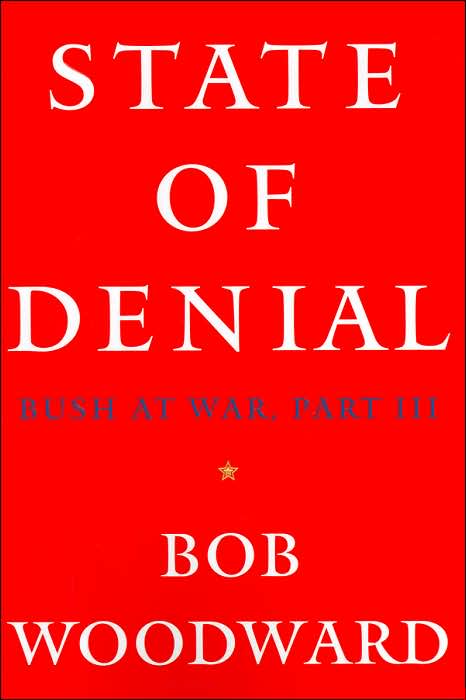
CIA Director George Tenet and his counterterrorism head Cofer Black sought an urgent meeting with then-national security adviser Condoleezza Rice on July 10, 2001, writes Bob Woodward in his new book “State of Denial.”

They went over top-secret intelligence pointing to an impending attack and “sounded the loudest warning” to the White House of a likely attack on the U.S. by Bin Laden.

Woodward writes that Rice was polite, but, “They felt the brushoff.”

Tenet and Black were both frustrated.

Black later calculated that all he needed was $500 million of covert action funds and reasonable authorization from President Bush to go kill Bin Laden and “he might be able to bring Bin Laden’s head back in a box,” Woodward writes.

Black claims the CIA had about “100 sources and subsources” in Afghanistan who could have helped carry out the hit.

The details of the incident are emerging just days after Sen. Hillary Clinton and former President Bill Clinton sparred with Rice over whether the Bush administration had tried to get Bin Laden before the terror attacks.

Update: Woodward also reports that President Bush was urged to dump Donald Rumsfeld twice after he won re-election, first by his then-Chief of Staff Andrew Card, the second time by Card and (interestingly enough) the First Lady. Looks like Andrew “Marketing Point of View” Card is trying to do some retroactive CYA after being replaced earlier this year.

From today’s Washington Post:

Former White House chief of staff Andrew Card on two occasions tried and failed to persuade President Bush to fire Defense Secretary Donald Rumsfeld, according to a new book by Bob Woodward that depicts senior officials of the Bush administration as unable to face the consequences of their policy in Iraq.

Card made his first attempt after Bush was reelected in November, 2004, arguing that the administration needed a fresh start and recommending that Bush replace Rumsfeld with former secretary of state James A. Baker III. Woodward writes that Bush considered the move, but was persuaded by Vice President Cheney and Karl Rove, his chief political adviser, that it would be seen as an expression of doubt about the course of the war and would expose Bush himself to criticism.

Card tried again around Thanksgiving, 2005, this time with the support of First Lady Laura Bush, who according to Woodward, felt that Rumsfeld’s overbearing manner was damaging to her husband. Bush refused for a second time, and Card left the administration last March, convinced that Iraq would be compared to Vietnam and that history would record that no senior administration officials had raised their voices in opposition to the conduct of the war.

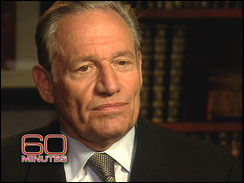
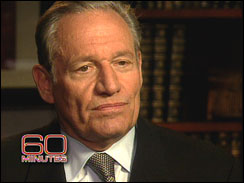
Photo from CBS News/60 Minutes

It’s that time of year again in Washington… not election season, but the release of Bob Woodward’s next book. Last time around, he broke the story of George “Slam Dunk” Tenet’s case for WMD in Iraq, among other things.

I’m not one to judge a book by its cover, but the title doesn’t sound too flattering to the Bush Administration.

Woodward taped an interview with Mike Wallace that will run on 60 Minutes this Sunday night. Here’s the teaser from CBS News:

According to Woodward, insurgent attacks against coalition troops occur, on average, every 15 minutes, a shocking fact the administration has kept secret. “It’s getting to the point now where there are eight-, nine-hundred attacks a week. That’s more than 100 a day. That is four an hour attacking our forces,” says Woodward.

The situation is getting much worse, says Woodward, despite what the White House and the Pentagon are saying in public. “The truth is that the assessment by intelligence experts is that next year, 2007, is going to get worse and, in public, you have the president and you have the Pentagon [saying], ‘Oh, no, things are going to get better,'” he tells Wallace. “Now there’s public, and then there’s private. But what did they do with the private? They stamp it secret. No one is supposed to know,” says Woodward.

“The insurgents know what they are doing. They know the level of violence and how effective they are. Who doesn’t know? The American public,” Woodward tells Wallace.

Woodward also reports that the president and vice president often meet with Henry Kissinger, who was President Richard Nixon’s secretary of state, as an adviser. Says Woodward, “Now what’s Kissinger’s advice? In Iraq, he declared very simply, ‘Victory is the only meaningful exit strategy.'” Woodward adds. “This is so fascinating. Kissinger’s fighting the Vietnam War again because, in his view, the problem in Vietnam was we lost our will.”

President Bush is absolutely certain that he has the U.S. and Iraq on the right course, says Woodward. So certain is the president on this matter, Woodward says, that when Mr. Bush had key Republicans to the White House to discuss Iraq, he told them, “I will not withdraw, even if Laura and Barney are the only ones supporting me.”

The book is being released one month before the election, so you can bank on political operatives who are going to read it cover to cover to pick and choose the tidbits that suit their opposition research and talking points. Whether any of Woodward’s revelations this time have an impact on the election remain to be seen. The person who got it worse last time was George Tenet. As a result of Woodward’s reporting, the phrase “slam dunk” is guaranteed to be in the first or second paragraph of his obituary.

I’ll watch 60 Minutes to see what else Woodward has up his sleeve, and I’ll pick up the book next week.

Update: The New York Times has obtained a copy of the book and written up some of the highlights.

The White House ignored an urgent warning in September 2003 from a top Iraq adviser who said that thousands of additional American troops were desperately needed to quell the insurgency there, according to a new book by Bob Woodward, the Washington Post reporter and author. The book describes a White House riven by dysfunction and division over the war.

The warning is described in “State of Denial,” scheduled for publication on Monday by Simon & Schuster. The book says President Bush’s top advisers were often at odds among themselves, and sometimes were barely on speaking terms, but shared a tendency to dismiss as too pessimistic assessments from American commanders and others about the situation in Iraq.

As late as November 2003, Mr. Bush is quoted as saying of the situation in Iraq: “I don’t want anyone in the cabinet to say it is an insurgency. I don’t think we are there yet.”

Secretary of Defense Donald H. Rumsfeld is described as disengaged from the nuts-and-bolts of occupying and reconstructing Iraq — a task that was initially supposed to be under the direction of the Pentagon — and so hostile toward Condoleezza Rice, then the national security adviser, that President Bush had to tell him to return her phone calls. The American commander for the Middle East, Gen. John P. Abizaid, is reported to have told visitors to his headquarters in Qatar in the fall of 2005 that “Rumsfeld doesn’t have any credibility anymore” to make a public case for the American strategy for victory in Iraq.

The book, bought by a reporter for The New York Times at retail price in advance of its official release, is the third that Mr. Woodward has written chronicling the inner debates in the White House after the Sept. 11 attacks, the invasion of Afghanistan, and the subsequent decision to invade Iraq. Like Mr. Woodward’s previous works, the book includes lengthy verbatim quotations from conversations and describes what senior officials are thinking at various times, without identifying the sources for the information.

Mr. Woodward writes that his book is based on “interviews with President Bush’s national security team, their deputies, and other senior and key players in the administration responsible for the military, the diplomacy, and the intelligence on Iraq.” Some of those interviewed, including Mr. Rumsfeld, are identified by name, but neither Mr. Bush nor Vice President Dick Cheney agreed to be interviewed, the book says.

The book describes a deep fissure between Colin L. Powell, Mr. Bush’s first secretary of state, and Mr. Rumsfeld: When Mr. Powell was eased out after the 2004 elections, he told Andrew H. Card Jr., the White House chief of staff, that “if I go, Don should go,” referring to Mr. Rumsfeld.

Mr. Card then made a concerted effort to oust Mr. Rumsfeld at the end of 2005, according to the book, but was overruled by President Bush, who feared that it would disrupt the coming Iraqi elections and operations at the Pentagon.

Vice President Cheney is described as a man so determined to find proof that his claim about weapons of mass destruction in Iraq was accurate that, in the summer of 2003, his aides were calling the chief weapons inspector, David Kay, with specific satellite coordinates as the sites of possible caches. None resulted in any finds.

The 537-page book describes tensions among senior officials from the very beginning of the administration. Mr. Woodward writes that in the weeks before the Sept. 11 attacks, Mr. Tenet believed that Mr. Rumsfeld was impeding the effort to develop a coherent strategy to capture or kill Osama bin Laden. Mr. Rumsfeld questioned the electronic signals from terrorism suspects that the National Security Agency had been intercepting, wondering whether they might be part of an elaborate deception plan by Al Qaeda.

On July 10, 2001, the book says, Mr. Tenet and his counterterrorism chief, J. Cofer Black, met with Ms. Rice at the White House to impress upon her the seriousness of the intelligence the agency was collecting about an impending attack. But both men came away from the meeting feeling that Ms. Rice had not taken the warnings seriously.

In the weeks before the Iraq war began, President Bush’s parents did not share his confidence that the invasion of Iraq was the right step, the book recounts. Mr. Woodward writes about a private exchange in January 2003 between Mr. Bush’s mother, Barbara Bush, the former first lady, and David L. Boren, a former chairman of the Senate Intelligence Committee and a Bush family friend.

The book says Mrs. Bush asked Mr. Boren whether it was right to be worried about a possible invasion of Iraq, and then to have confided that the president’s father, former President George H. W. Bush, “is certainly worried and is losing sleep over it; he’s up at night worried.”

Mr. Rumsfeld reached into political matters at the periphery of his responsibilities, according to the book. At one point, Mr. Bush traveled to Ohio, where the Abrams battle tank was manufactured. Mr. Rumsfeld phoned Mr. Card to complain that Mr. Bush should not have made the visit because Mr. Rumsfeld thought the heavy tank was incompatible with his vision of a light and fast military of the future. Mr. Woodward wrote that Mr. Card believed that Mr. Rumsfeld was “out of control.”

The fruitless search for unconventional weapons caused tension between Vice President Cheney’s office, the C.I.A. and officials in Iraq. Mr. Woodward wrote that Mr. Kay, the chief weapons inspector in Iraq, e-mailed top C.I.A. officials directly in the summer of 2003 with his most important early findings.

At one point, when Mr. Kay warned that it was possible the Iraqis might have had the capability to make such weapons but did not actually produce them, waiting instead until they were needed, the book says he was told by John McLaughlin, the C.I.A.’s deputy director: “Don’t tell anyone this. This could be upsetting. Be very careful. We can’t let this out until we’re sure.”

Mr. Cheney was involved in the details of the hunt for illicit weapons, the book says. One night, Mr. Woodward wrote, Mr. Kay was awakened at 3 a.m. by an aide who told him Mr. Cheney’s office was on the phone. It says Mr. Kay was told that Mr. Cheney wanted to make sure he had read a highly classified communications intercept picked up from Syria indicating a possible location for chemical weapons.

Interesting but not surprising that Bush and Cheney did not agree to be interviewed for this book. My guess is that when they heard about the stuff Woodward had uncovered, they decided to cut him off.


I’ve been out of town the past few days so I have not been able to get my regular dose of the Daily Show and the Colbert Report.

Stephen Colbert took the morning shows out to the woodshed and proceeded to systematically tear them apart using sarcasm alone over their handling of his “interview” with Rep. Robert Wexler (D-Florida).

Moral of the story: Did everyone forget Colbert’s skewering of President Bush at the White House Correspondents’ Association dinner earlier this year? If you mess with this man, you do so at your own peril, and it won’t be pretty.

Closing Up Shop in DC

Posted: July 26, 2006 in Beltway Drama, Music

I’ll be off this thing for the next couple of days while I pack up my apartment in anticipation for the big move next Monday. Once all my stuff is packed up and ready to go, if I have time I’ll sit down and do some writing before I leave town.

In the meantime, I’ve updated the playlist in the right hand column. All of the songs contain references to or are about California or Los Angeles, some good (by that I mean positive, happy, cheery, etc.), some not.

The Associated Press has an interesting story on how convicted former congressman Randy “Duke” Cunningham used the classified appropriations process in his capacity as a member of the House Intelligence Committee to steer appropriations money for projects of his choice that would “benefit him or his associates.”

Here’s the basics of the AP story:

An independent investigation has found that imprisoned former Rep. Randy “Duke” Cunningham took advantage of secrecy and badgered congressional aides to help slip items into classified bills that would benefit him and his associates.

The finding comes from Michael Stern, an outside investigator hired by the House Intelligence Committee to look into how Cunningham was able to carry out the scheme. Stern is working with the committee to fix vulnerabilities in the way top-secret legislation is written, said congressional officials who spoke on condition of anonymity because the committee still is being briefed on Stern’s findings.

Cunningham’s case has put a stark spotlight on the oversight of classified – or “black” – budgets. Unlike legislation dealing with social and economic issues, intelligence bills and parts of defense bills are written in private, in the name of national security.

That means it is up to members of Congress and select aides with security clearances to ensure that legislation is appropriate.

Speaking from personal experience at my previous job where on a few occasions I had to go through similar documents and trying to fact check or analyze the data they contain, government budget documents which are available to the public generally tend to be monstrous in size and mind-numbingly dull in scope and detail to begin with. What makes this budget bill different is that anything dealing with the intelligence community budget is classified, because the U.S. government does not want to give any hints to foreign governments or intelligence agencies any ideas about what the CIA, NSA, NRO, NGA, DIA, or other agencies in the U.S. intelligence community alphabet soup might be up to based on how much money they’re getting from Congress.

As the AP story points out, pork projects buried in classified budgets are nothing new, citing Senators Robert Byrd (D-West Virginia) and Richard Shelby (R-Alabama) as examples. However, given all of the recent controversies involving the practice of earmarking, as well as some of the projects which were going to receive congressional funding (i.e. the Bridge to Nowhere in Alaska), it would not be surprising to me if at some point in the future, a massive overhaul of the appropriations and earmarking process will be necessary.

Finally, the article also adds that when dealing with classified budgets the judgment is strictly up to the committee members and a handful of aides who have the appropriate security clearances. Because of this, no outside interest groups (i.e. Citizens Against Government Waste or POGO) or the media can go through it and look for possible evidence of pork projects, wasteful spending, conflicts of interest, or corruption.

On Tuesday, former Christian Coalition organizer Ralph Reed became the first victim of the Jack Abramoff scandal at the ballot box.

According to Rich Lowry at the Corner, in trying to explain his loss Reed’s people point the finger directly at John McCain and the press (emphasis is mine):

Cagle v. Reed [Rich Lowry]

Here’s the view of what happened from the Reed camp: Once the Abramoff stuff exploded, it was going to be a very tough road for Reed. Glen Bolger did a poll for the campaign in January showing that it was possible for Reed to win, but his negatives were very high and he would have to squeak by. Reed had a choice to make, and decided to stay in the race and try to make it happen. In the end, soft Republicans appear to have broken very strongly against him in the suburbs. There may have been some cross-over Democratic votes in the open primary, but that alone can’t account for a 54-46% loss. Reed’s connection to the Abramoff stuff had broken back in the summer of 2004, so it couldn’t have been predicted that it would be such a huge deal even now. But it was. The Reed camp blames John McCain for playing payback for his 2000 primary defeat with a campaign of leaks, and the press, of course, was happy to pile on. The Atlanta Journal-Constitution ran dozens and dozens of stories about the scandal. Outside liberal groups might have spent upwards of a quarter-million on the race. The Reed team felt good at the close of the race, but, in the end, they just couldn’t scratch it out.

Reed has gone a long way from this:

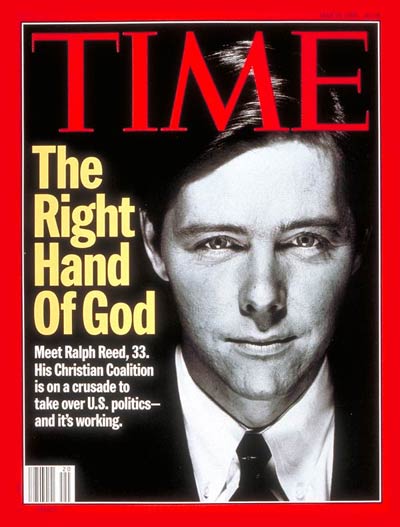
Time Magazine cover boy in 1995:

The New Hampshire senate, which usually deigns to listen only to would-be Presidents, paid close attention to his message. The ranks of conservative Christians, Reed said, are now “too large, too diverse, too significant to be ignored by either major political party.” Not long ago, America’s Christian right was dismissed as a group of pasty-faced zealots, led by divisive televangelists like Jerry Falwell, who helped yank the Republican Party so far to the right that moderates were frightened away. But Reed has emerged as the movement’s fresh face, the choirboy to the rescue, a born-again Christian with a fine sense of the secular mechanics of American politics. His message, emphasizing such broadly appealing themes as support for tax cuts, has helped make the Christian Coalition one of the most powerful grass-roots organizations in American politics. Its 1.6 million active supporters and $25 million annual budget, up from 500,000 activists and a $14.8 million budget just two years ago, hold a virtual veto on the Republican nominee for President, and will exert an extraordinary influence over who will occupy the Oval Office beginning in 1997.

To this:

(Abramoff is the one furthest to the left wearing the black shirt and baseball cap. Reed is the one to Abramoff’s immediate left, wearing khakis and a long sleeve shirt.)
From the Washington Post:

[Abramoff] looked to Reed, the former Christian Coalition leader who operated several consulting companies. Reed has acknowledged receiving as much as $4 million from Abramoff and his associate, Scanlon, to organize grass-roots anti-gambling campaigns in Louisiana and Texas. The money came from casino-rich Indian tribes, including the Coushattas, but Reed said that although he knew of Abramoff’s connection to the tribes, he did not know until media accounts surfaced last summer that his fees came from gambling proceeds.

Reed then turned to Dobson to marshal his vast network of evangelicals, Abramoff’s e-mails show.

If you thought that arrangement sounded bad, their own words in e-mails obtained by investigators and the press make it sound even worse. Again, from the Washington Post (emphasis is mine):

Among those e-mails was one from Reed to Abramoff in late 1998: “I need to start humping in corporate accounts! . . . I’m counting on you to help me with some contacts.” Within months, Abramoff hired him to lobby on behalf of the Mississippi Band of Choctaws, who were seeking to prevent competitors from setting up facilities in nearby Alabama.

In 1999, Reed e-mailed Abramoff after submitting a bill for $120,000 and warning that he would need as much as $300,000 more: “We are opening the bomb bays and holding nothing back.”

In 2004, when the casino payments to Reed were disclosed, Reed issued a statement declaring “no direct knowledge of their [Abramoff’s law firm’s] clients or interests.” In 2005, however, Senate investigators released a 1999 e-mail from Abramoff to Reed explicitly citing the client: “It would be really helpful if you could get me invoices [for services performed] as soon as possible so I can get Choctaw to get us checks ASAP.”

One of the most damaging e-mails was sent by Abramoff to partner Michael Scanlon, complaining about Reed’s billing practices and expenditure claims: “He is a bad version of us! No more money for him.” Scanlon and Abramoff have pleaded guilty to defrauding clients.

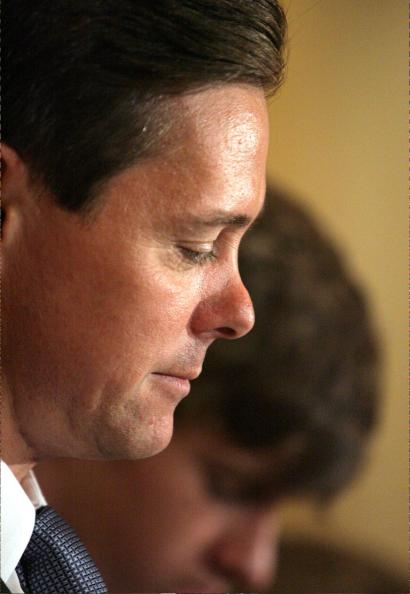
And finally to this:

(Photo from the Atlanta Journal-Constitution)

I recommend reading the entire AJC article linked above, but here’s a key passage:

Reed often blamed “the liberal media” for focusing on the his dealings with Abramoff, but in fact many evangelical Christians were also disaffected.

Clint Austin of Marietta is a former Reed employee who ran Reed’s successful bid to become state Republican Party chairman in 2001. On Monday, Austin, now a state Capitol lobbyist, posted on the Internet an article in which he explained why he would not vote for Reed.

“My reason for abandoning my support of Ralph is simple: Ralph Reed’s words and actions do not match up,” Austin wrote.

I’d say Tom DeLay was the first political victim of the Abramoff scandal, but he decided to abandon his re-election effort instead of sticking around to run against Nick Lampson. Both Texas state parties are awaiting a ruling by the Fifth Circuit Court of Appeals to see whether they will uphold or overturn the ruling by U.S. District Judge Sam Sparks earlier this month forcing DeLay back in the race. However, DeLay has additional problems with the ongoing investigation by DA Ronnie Earle in Austin, so his legal and political problems weren’t only Abramoff-related.

How this will bode for other Abramoff-tainted lawmakers (i.e. Bob Ney, Conrad Burns) remains to be seen, but since the Washington Post reported the first Abramoff story back in 2004 and kept revealing more about his lobbying scheme, the name Abramoff has become politically radioactive in DC. Whether this will matter to their constituents back home when both men are up for re-election in November, we’ll have to keep watching both races as well as any further revelations from Abramoff-related investigations by the government and the media.

For further reference material, check out this section of the Washington Post archiving all of its Abramoff stories, for which they won a Pulitzer Prize.

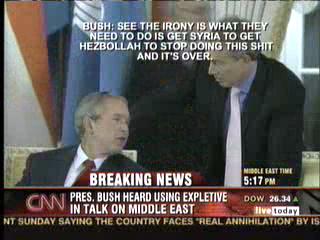
Screenshot from CNN, image from ThinkProgress.

President Bush and British Prime Minister Tony Blair had a rather interesting and candid exchange over how to resolve the current escalation of violence in the Middle East. Unfortunately for them, it appears that they didn’t know they were on camera or that the microphone nearby was on and was picking up every word.

Take a look.

Sky News has a full transcript of the conversation.