Archive for the ‘National Security’ Category

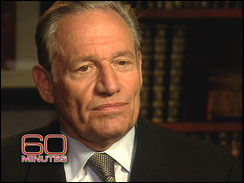
Photo from CBS News/60 Minutes

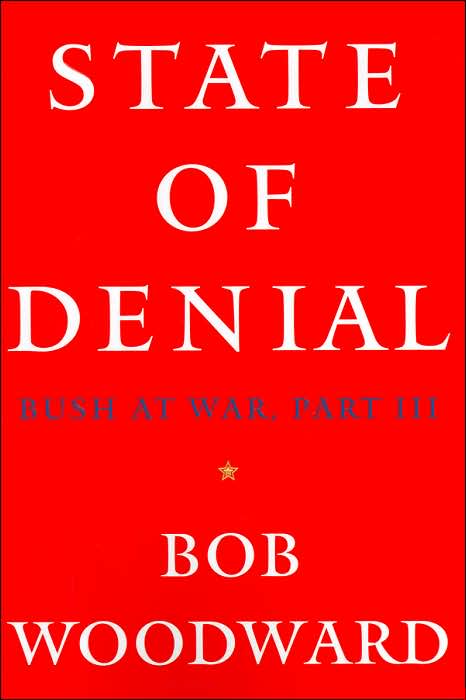
It’s that time of year again in Washington… not election season, but the release of Bob Woodward’s next book. Last time around, he broke the story of George “Slam Dunk” Tenet’s case for WMD in Iraq, among other things.

I’m not one to judge a book by its cover, but the title doesn’t sound too flattering to the Bush Administration.
Woodward taped an interview with Mike Wallace that will run on 60 Minutes this Sunday night. Here’s the teaser from CBS News:

According to Woodward, insurgent attacks against coalition troops occur, on average, every 15 minutes, a shocking fact the administration has kept secret. “It’s getting to the point now where there are eight-, nine-hundred attacks a week. That’s more than 100 a day. That is four an hour attacking our forces,” says Woodward.

The situation is getting much worse, says Woodward, despite what the White House and the Pentagon are saying in public. “The truth is that the assessment by intelligence experts is that next year, 2007, is going to get worse and, in public, you have the president and you have the Pentagon [saying], ‘Oh, no, things are going to get better,'” he tells Wallace. “Now there’s public, and then there’s private. But what did they do with the private? They stamp it secret. No one is supposed to know,” says Woodward.

“The insurgents know what they are doing. They know the level of violence and how effective they are. Who doesn’t know? The American public,” Woodward tells Wallace.

Woodward also reports that the president and vice president often meet with Henry Kissinger, who was President Richard Nixon’s secretary of state, as an adviser. Says Woodward, “Now what’s Kissinger’s advice? In Iraq, he declared very simply, ‘Victory is the only meaningful exit strategy.'” Woodward adds. “This is so fascinating. Kissinger’s fighting the Vietnam War again because, in his view, the problem in Vietnam was we lost our will.”

President Bush is absolutely certain that he has the U.S. and Iraq on the right course, says Woodward. So certain is the president on this matter, Woodward says, that when Mr. Bush had key Republicans to the White House to discuss Iraq, he told them, “I will not withdraw, even if Laura and Barney are the only ones supporting me.”

The book is being released one month before the election, so you can bank on political operatives who are going to read it cover to cover to pick and choose the tidbits that suit their opposition research and talking points. Whether any of Woodward’s revelations this time have an impact on the election remain to be seen. The person who got it worse last time was George Tenet. As a result of Woodward’s reporting, the phrase “slam dunk” is guaranteed to be in the first or second paragraph of his obituary.

I’ll watch 60 Minutes to see what else Woodward has up his sleeve, and I’ll pick up the book next week.

Update: The New York Times has obtained a copy of the book and written up some of the highlights.

The White House ignored an urgent warning in September 2003 from a top Iraq adviser who said that thousands of additional American troops were desperately needed to quell the insurgency there, according to a new book by Bob Woodward, the Washington Post reporter and author. The book describes a White House riven by dysfunction and division over the war.

The warning is described in “State of Denial,” scheduled for publication on Monday by Simon & Schuster. The book says President Bush’s top advisers were often at odds among themselves, and sometimes were barely on speaking terms, but shared a tendency to dismiss as too pessimistic assessments from American commanders and others about the situation in Iraq.

As late as November 2003, Mr. Bush is quoted as saying of the situation in Iraq: “I don’t want anyone in the cabinet to say it is an insurgency. I don’t think we are there yet.”

Secretary of Defense Donald H. Rumsfeld is described as disengaged from the nuts-and-bolts of occupying and reconstructing Iraq — a task that was initially supposed to be under the direction of the Pentagon — and so hostile toward Condoleezza Rice, then the national security adviser, that President Bush had to tell him to return her phone calls. The American commander for the Middle East, Gen. John P. Abizaid, is reported to have told visitors to his headquarters in Qatar in the fall of 2005 that “Rumsfeld doesn’t have any credibility anymore” to make a public case for the American strategy for victory in Iraq.

The book, bought by a reporter for The New York Times at retail price in advance of its official release, is the third that Mr. Woodward has written chronicling the inner debates in the White House after the Sept. 11 attacks, the invasion of Afghanistan, and the subsequent decision to invade Iraq. Like Mr. Woodward’s previous works, the book includes lengthy verbatim quotations from conversations and describes what senior officials are thinking at various times, without identifying the sources for the information.

Mr. Woodward writes that his book is based on “interviews with President Bush’s national security team, their deputies, and other senior and key players in the administration responsible for the military, the diplomacy, and the intelligence on Iraq.” Some of those interviewed, including Mr. Rumsfeld, are identified by name, but neither Mr. Bush nor Vice President Dick Cheney agreed to be interviewed, the book says.

The book describes a deep fissure between Colin L. Powell, Mr. Bush’s first secretary of state, and Mr. Rumsfeld: When Mr. Powell was eased out after the 2004 elections, he told Andrew H. Card Jr., the White House chief of staff, that “if I go, Don should go,” referring to Mr. Rumsfeld.

Mr. Card then made a concerted effort to oust Mr. Rumsfeld at the end of 2005, according to the book, but was overruled by President Bush, who feared that it would disrupt the coming Iraqi elections and operations at the Pentagon.

Vice President Cheney is described as a man so determined to find proof that his claim about weapons of mass destruction in Iraq was accurate that, in the summer of 2003, his aides were calling the chief weapons inspector, David Kay, with specific satellite coordinates as the sites of possible caches. None resulted in any finds.

The 537-page book describes tensions among senior officials from the very beginning of the administration. Mr. Woodward writes that in the weeks before the Sept. 11 attacks, Mr. Tenet believed that Mr. Rumsfeld was impeding the effort to develop a coherent strategy to capture or kill Osama bin Laden. Mr. Rumsfeld questioned the electronic signals from terrorism suspects that the National Security Agency had been intercepting, wondering whether they might be part of an elaborate deception plan by Al Qaeda.

On July 10, 2001, the book says, Mr. Tenet and his counterterrorism chief, J. Cofer Black, met with Ms. Rice at the White House to impress upon her the seriousness of the intelligence the agency was collecting about an impending attack. But both men came away from the meeting feeling that Ms. Rice had not taken the warnings seriously.

In the weeks before the Iraq war began, President Bush’s parents did not share his confidence that the invasion of Iraq was the right step, the book recounts. Mr. Woodward writes about a private exchange in January 2003 between Mr. Bush’s mother, Barbara Bush, the former first lady, and David L. Boren, a former chairman of the Senate Intelligence Committee and a Bush family friend.

The book says Mrs. Bush asked Mr. Boren whether it was right to be worried about a possible invasion of Iraq, and then to have confided that the president’s father, former President George H. W. Bush, “is certainly worried and is losing sleep over it; he’s up at night worried.”

Mr. Rumsfeld reached into political matters at the periphery of his responsibilities, according to the book. At one point, Mr. Bush traveled to Ohio, where the Abrams battle tank was manufactured. Mr. Rumsfeld phoned Mr. Card to complain that Mr. Bush should not have made the visit because Mr. Rumsfeld thought the heavy tank was incompatible with his vision of a light and fast military of the future. Mr. Woodward wrote that Mr. Card believed that Mr. Rumsfeld was “out of control.”

The fruitless search for unconventional weapons caused tension between Vice President Cheney’s office, the C.I.A. and officials in Iraq. Mr. Woodward wrote that Mr. Kay, the chief weapons inspector in Iraq, e-mailed top C.I.A. officials directly in the summer of 2003 with his most important early findings.

At one point, when Mr. Kay warned that it was possible the Iraqis might have had the capability to make such weapons but did not actually produce them, waiting instead until they were needed, the book says he was told by John McLaughlin, the C.I.A.’s deputy director: “Don’t tell anyone this. This could be upsetting. Be very careful. We can’t let this out until we’re sure.”

Mr. Cheney was involved in the details of the hunt for illicit weapons, the book says. One night, Mr. Woodward wrote, Mr. Kay was awakened at 3 a.m. by an aide who told him Mr. Cheney’s office was on the phone. It says Mr. Kay was told that Mr. Cheney wanted to make sure he had read a highly classified communications intercept picked up from Syria indicating a possible location for chemical weapons.

Interesting but not surprising that Bush and Cheney did not agree to be interviewed for this book. My guess is that when they heard about the stuff Woodward had uncovered, they decided to cut him off.


Un-Able Danger

Posted: September 22, 2006 in National Security

NY Times: Claim 9/11 Terrorists Were Identified Is Rejected

Another 9/11 conspiracy theory shot to hell.

On the bright side, at least ABC’s “Path to 9/11” didn’t show or mention the Able Danger Unit along with the other inaccuracies in the series..

Facts Are Stupid Things…

Posted: September 16, 2006 in Movies, National Security

I recently wrote this fact check/editorial piece for the Daily Trojan on ABC’s controversial miniseries “The Path to 9/11.” For the sake of brevity, I was unable to dissect each scene and cite sources as in depth as I would have liked. So as a companion to that, I’ve posted my research with source information in this entry.

Unless otherwise mentioned, my main sources of research were:

The 9/11 Commission Report
Steve Coll, “Ghost Wars: The Secret History of the CIA, Afghanistan, and bin Laden from the Soviet Invasion to September 10, 2001.”
Richard Clarke, “Against All Enemies: Inside America’s War on Terror.”

Movie: In the most controversial scene of the movie, a CIA operative and Northern Alliance fighters in Afghanistan had Osama bin Laden in their sights, but aborted the mission after a phone call with Clinton National Security Advisor Sandy Berger.
Reality: Both Berger and Clinton/Bush counterterrorism czar Richard Clarke sharply dispute this scene. There is no evidence that the CIA at any point had Osama bin Laden in their sights to call in an air strike.

The original cut of the movie had Berger hanging up the phone before the CIA team decided to abort the mission. This scene was cut before Berger hangs up the phone. However, an anti-Berger/anti-Clinton comment [“Are there any men left in Washington or are they all cowards?”] by Northern Alliance leader Ahmed Shah Massoud was left in the movie.

According to the 9/11 Commission, the decision to abort the operations which were never carried out were ultimately based on the recommendations of CIA Director George Tenet, not Berger. Because this never happened, a scene in the movie a few minutes after the August 1998 bombings on the East Africa embassies where a CIA analyst tearfully barges into a conference room and blasts George Tenet for not ordering the strike on bin Laden shown in the movie is also inaccurate.

The following is a timeline of attempts during the Clinton Administration to capture or kill Osama bin Laden, as documented by the 9/11 Commission:
Fall of 1997: The CIA draws up preliminary plans to capture bin Laden alive.
June 1998: The CIA plans a raid to capture bin Laden for June 23, with intentions of getting him out of Afghanistan within four weeks. Although the plan was never presented to the White House for a decision, this operation was aborted by CIA Director George Tenet at the recommendation of his operations officers.
August 1998: After the East Africa embassy bombings in August, the Clinton Administration retaliates with missile strikes in Afghanistan and Sudan with the intention of killing bin Laden.
September-October 1998: Afghan assets of the CIA claim they attempted to ambush Bin Laden four times with the intention of capturing him alive, with no success.
December 1998: Senior officials decide against recommending another missile strike against bin Laden after getting a possible lead on his location. Clinton later modifies his previous order, authorizing the Afghan assets to kill bin Laden if capturing him was not possible.
February 1999: Intelligence indicating bin Laden’s presence at a camp in Afghanistan. The proposed missile strike is eventually called off after discussions with Tenet who felt the intelligence was unreliable.
May 1999: Several CIA assets report on bin Laden’s location over a period of five days. Berger believes Tenet made the decision against the strike.
The 9/11 Commission considered this “perhaps the last, and most likely the best” opportunity to target bin Laden with a missile strike before 9/11. No missile strikes against bin Laden were considered again until after 9/11.
[Sources: 9/11 Commission, p. 108-121, 126-143. Coll, p. 371-396, 410-412, 421-28, 445-450. Clarke, p. 148-154, 188-190, 199-204.]

Movie: The CIA spotted Osama bin Laden while testing a prototype for an unmanned aerial vehicle.
Reality: This is true, although the depiction in the movie is highly exaggerated. In the movie, it took place after the USS Cole bombing.
Steve Coll and the 9/11 Commission reported that the CIA began a series of test flights on the Predator in September of 2000 continuing for several months. The CIA spotted a man believed to be bin Laden two or three times while testing unmanned Predator drones equipped with video cameras. Ten of the fifteen test flights were considered successful, according to the 9/11 Commission.

The video footage of bin Laden seen in the film is also grossly exaggerated, showing near perfect and clear color images of him in a training camp. The actual footage, which was leaked to NBC News approximately two years ago, was grainier and shot from a much greater distance than the footage shown in the movie.

The film is inaccurate showing that a Predator was lost during the test run after an encounter with a Taliban jet. A jet was scrambled to intercept the Predator during one test flight but it flew by the Predator without even seeing it. On one occasion, a plane crash landed shortly after takeoff. This resulted in a bureaucratic turf war between the CIA and the Air Force over who was going to get stuck with the repair bill for the $3 million plane.

The film is accurate when it says the planes were not weaponized at the time, so were not used to attempt to kill bin Laden. Since 9/11, Predator drones have been armed with Hellfire missiles and used in at least two operations to assassinate al Qaeda operatives.
[Sources: 9/11 Commission, p. 187-190. Coll, p. 520-531. Clarke, p. 220-222. NBC News, “Osama bin Laden: Missed Opportunities.”]

Movie: Condoleezza Rice reads the August 6, 2001 Presidential Daily Brief (PDB) warning, “Bin Laden Determined to Strike in U.S.”
Reality: Rice testified before the 9/11 Commission that the PDB contained “historical information based on old reporting,” “no new threat information,” and that it did not “warn of any coming attacks inside the United States.” Her characterization of the PDB, which was first revealed by the Washington Post and later declassified at the request of the 9/11 Commission, is accurate.

The 9/11 Commission also noted that this was the 36th PDB item that year which was related to bin Laden or al Qaeda, and the first devoted to a possible attack in the United States.

The movie does not depict President Bush receiving this briefing. According to Ron Suskind’s book “The One Percent Doctrine,” after he was given this briefing by a CIA officer while on vacation at his Crawford ranch, President Bush responded, “All right, you’ve covered your ass, now.”
[Sources: 9/11 Commission, p. 260-263. Transcript of Condoleezza Rice’s testimony before the 9/11 Commission. Suskind, p. 1-2]

Movie: While chairing the Bush Administration’s first principals meeting on terrorism on September 4, 2001, Condoleezza Rice says, “Morning, gentlemen. As a result of the August 6 Presidential Daily Briefing, the president is tired of swatting flies. He believes Al Qaeda is a real threat, and he wants to consider real action. He specifically asked about the armed Predator. Where are we with that?”
Reality: Condoleezza Rice and others recalled the President saying “I’m tired of swatting at flies,” and also reportedly said “I’m tired of playing defense. I want to play offense. I want to take the fight to the terrorists,” in early March of 2001, according to the 9/11 Commission Report.

Regarding the Predator, Richard Clarke and CIA Counterterrorism official Cofer Black were early and vocal proponents of the program, especially a weaponized version of it. There is some dispute whether there was an endorsement of resuming flights during an April 30, 2001 meeting, but Rice and her deputy Stephen Hadley ultimately “went along with the CIA and the Pentagon, holding off on reconnaissance flights until the armed Predator was ready,” according to the 9/11 Commission. The Commission also reported that Hadley tried to hurry the development of the armed Predator, directing Deputy CIA Director John McLaughlin, Deputy Secretary of Defense Paul Wolfowitz, and Joint Chiefs Vice Chairman Richard Myers to “deploy Predators capable of being armed no later than September 1.”

The Principals Committee had its first meeting on al Qaeda, chaired by Condoleezza Rice, on September 4, 2001. Clarke sent Rice a memo that day which reads, “are we serious about dealing with the al Qida threat?…Is al Qida a big deal?…Decision makers should imagine themselves on a future day when the CSG has not succeeded in stopping al Qida attacks and hundreds of Americans lay dead in several countries, including the US.”

After being briefed by her staff that the weaponized Predator was not ready for deployment, Rice commented about potential for using it in spring of 2002.
[Sources: 9/11 Commission p. 202, 210-213. Clarke, p. 237-238.]

Movie: Ahmed Shah Massoud warns the CIA that an operation is underway in the United States involving aviation hijackings shortly before he is assassinated.
Reality: There is no evidence that Massoud ever warned the CIA about the 9/11 plot, although in the movie he is shown using alarmist language about the plot, noting that it would happen in the United States and would involve aviation hijackings. However, during a press conference in France on April 5, 2001, he warned “If President Bush doesn’t help us, then these terrorists will damage the United States and Europe very soon – and it will be too late.”
[Source: Coll, p. 555]

Movie: 9/11 hijacker Mohammed Atta sets off red flags when trying to check in for his American Airlines flight at Logan International Airport in Boston.
Reality: Atta was screened by U.S. Airways employees in Portland, Maine after being selected by a computerized pre-screening system, not American Airways employees in Boston. However, three other members of Atta’s hijacking team were chosen for screening at Logan. All five members of the Atta team cleared the security checkpoint and were able to board their flight. American Airlines has issued a press release calling this scene “inaccurate and irresponsible,” and according to Ad Week, is said to be considering legal action against ABC and pulling all of its advertising from the network.
[Source: 9/11 Commission, p. 1-2]

Movie: Vice President Cheney has a conversation with President Bush the morning of 9/11 where the President gives him the order to shoot down hijacked planes.
Reality: The 9/11 Commission was unable to find any conclusive evidence that this phone call ever took place. From the report:

Among the sources that reflect other important events of that morning, there is no documentary evidence for this call, but the relevant sources are incomplete. Others nearby who were taking notes, such as the Vice President’s chief of staff, Scooter Libby, who sat next to him, and Mrs. Cheney, did not note a call between the President and Vice President immediately after the Vice President entered the conference room.

Vanity Fair recently obtained the entire unedited NORAD tapes from 9/11 and did an extensive analysis of the contents. The magazine reported, “President Bush would finally grant commanders the authority to give that order [to shoot down the planes] at 10:18, which—though no one knew it at the time—was 15 minutes after the attack was over.”

Richard Clarke, who was in a different room of the White House than the Vice President and Condoleezza Rice when this happens, remembers getting a message relayed to him by a military aide saying “Tell the Pentagon they have authority from the President to shoot down hostile aircraft, repeat, they have authority to shoot down hostile aircraft.” What is not clear from his narrative is at what time he got this message ordering to shoot down the planes, before or after the 10:18 time reported in Vanity Fair.
[Sources: 9/11 Commission Report, p. 40-42. Vanity Fair “9/11 Live: The NORAD Tapes.” September 2006 issue, p. 262-285. Clarke, p. 1-8]

Henry Schuster has a new column this week exploring the reasons behind the popular support for Hezbollah within the Lebanese Shiite community.

Schuster sums it all up in one sentence:

People here see Hezbollah as a political movement and a social service provider as much as it is a militia that delivers the goods for its followers, in this traditionally poor and dispossessed Shiite community.

The solidarity with Hezbollah is not limited to purely religious grounds. Schuster reports that a CNN crew found Hezbollah had moved into a school in a Christian neighborhood of Beirut that was being used as a shelter by refugees and were organizing relief efforts.

The Counterterrorism Blog has an entry from its special correspondent on the ground in Beirut reporting that Hezbollah has penetrated Christian areas in Lebanon.

This is as much a failure of fulfilling basic social services by the government as it is a good PR and grassroots outreach and recruitment effort by Hezbollah. Until the Lebanese government and the international community tries to break the goodwill and long standing relationship between Hezbollah and the Lebanese Shiites by offering them other options to Hezbollah, it will continue to be business as usual even after the current crisis is over.

Photo from the Nuclear Weapon Archive.

The Washington Post has a front page story today on the expansion of Pakistan’s nuclear weapons program.

From the article:

Pakistan has begun building what independent analysts say is a powerful new reactor for producing plutonium, a move that, if verified, would signal a major expansion of the country’s nuclear weapons capabilities and a potential new escalation in the region’s arms race.

Satellite photos of Pakistan’s Khushab nuclear site show what appears to be a partially completed heavy-water reactor capable of producing enough plutonium for 40 to 50 nuclear weapons a year, a 20-fold increase from Pakistan’s current capabilities, according to a technical assessment by Washington-based nuclear experts.

The assessment’s key judgments were endorsed by two other independent nuclear experts who reviewed the commercially available satellite images, provided by Digital Globe, and supporting data. In Pakistan, officials would not confirm or deny the report, but a senior Pakistani official, speaking on condition of anonymity, acknowledged that a nuclear expansion was underway.

“Pakistan’s nuclear program has matured. We’re now consolidating the program with further expansions,” the official said. The expanded program includes “some civilian nuclear power and some military components,” he said.

The development raises fresh concerns about a decades-old rivalry between Pakistan and India. Both countries already possess dozens of nuclear warheads and a variety of missiles and other means for delivering them.

This is coming from the same country that was the hub of the A.Q. Khan nuclear proliferation network, which sold nuclear technology to Libya, Iran, and North Korea.

This is also a country with a social element that has strong Islamist, anti-Western sentiment bubbling under the surface. The head of state, General Pervez Musharraf, is caught in a very delicate political balancing act, where he has to try to keep the United States and its allies happy with assistance, intelligence, and cooperation in the fight against terrorism and rebuliding Afghanistan, as well as the more extreme elements of Pakistani society which have already plotted to assassinate him three times and tried it twice.

About a year ago, CNN Presents did a one hour program on the possibility of a terrorist attack involving nuclear or radiological material. One of the scenarios explored in the program as to how a terrorist organization might get the materials for an attack was through Pakistan. One worst case scenario for this would be if Musharraf is overthrown or assassinated, and a new Islamist government hostile towards the west takes power. If that happened, Pakistan’s nuclear arsenal would effectively be at its disposal to use against whoever it wants.

Also worth keeping in mind is the historical cultural and political tensions between India and Pakistan which have flared up from time to time. It wasn’t too long ago that Pakistan and India came very close to breaking out into a full-fledged war, and both sides had nuclear weapons stockpiles ready to go.

More recently, you had President Bush’s visit to India back in March which resulted in a landmark deal with the Indian government on its civilian nuclear program, and the train attacks in Mumbai which killed 174 people a few weeks ago, leading some to speculate whether Pakistan was involved.

Other than in the Middle East, I couldn’t think of a worse possible scenario where two opposing countries with a history of conflict that also have nuclear weapons aimed at each other and ready to fire at any moment.

The Counterterrorism Blog offers some insight into a disturbing potential development in the current violence in the Middle East, attributed to news first reported by the Jerusalem Post: that Hezbollah sleeper cells set up outside of Lebanon with backing from Iran have been placed on standby to possibly carry out terror attacks against Israeli or Jewish targets around the world.

I’m copying and pasting their analysis here, but if you want to read the relevant excerpts of the original Jerusalem Post story, head over to their site.

A word of caution: At this point, there’s no source for the claim that Hizballah cells have been put on standby. The first paragraph states that the Jerusalem Post learned this today, but leaves out any mention of who the Post learned this from. Although the second paragraph cites Shin Bet as a source, this is only for confirmation that it “instructed embassies, consulates and Jewish institutions it was responsible for abroad to raise their level of awareness” — it doesn’t state that Shin Bet told the Post that Hizballah cells were put on standby. Putting these institutions on alert seems a wise move even if there were no evidence that Hizballah cells were on standby.

Counterterrorism consultant Dan Darling comments in an e-mail to me: “I expect that Hezbollah cells, sleeper or otherwise, were put on notice that they might be called upon to carry out attacks in the event that things started to get nasty. If you’re running an international terrorist organization, this would seem to me to be a prudent move before you engage in an unprovoked cross-border raid and kidnapping that seems almost certain to spark a regional conflict. I’ve been operating under the assumption that they had cells in place to carry off attacks at least in Europe should they desire to utilize them since the conflict first started . . . .”

This story is worth following, as Hizballah’s activation of sleeper cells would substantially raise what are already large stakes.

This is not the plot to an episode of 24. This is a very real and disturbing possibility which if true, could escalate the violence even further in the hornet’s nest that is now the Middle East. Given their background and track record (see pages 8-9 of the file), and more info available here, I would not take this lightly if I were involved in any counterterrorism, intelligence, or diplomatic circles working on a solution to this crisis.

The Associated Press has an interesting story on how convicted former congressman Randy “Duke” Cunningham used the classified appropriations process in his capacity as a member of the House Intelligence Committee to steer appropriations money for projects of his choice that would “benefit him or his associates.”

Here’s the basics of the AP story:

An independent investigation has found that imprisoned former Rep. Randy “Duke” Cunningham took advantage of secrecy and badgered congressional aides to help slip items into classified bills that would benefit him and his associates.

The finding comes from Michael Stern, an outside investigator hired by the House Intelligence Committee to look into how Cunningham was able to carry out the scheme. Stern is working with the committee to fix vulnerabilities in the way top-secret legislation is written, said congressional officials who spoke on condition of anonymity because the committee still is being briefed on Stern’s findings.

Cunningham’s case has put a stark spotlight on the oversight of classified – or “black” – budgets. Unlike legislation dealing with social and economic issues, intelligence bills and parts of defense bills are written in private, in the name of national security.

That means it is up to members of Congress and select aides with security clearances to ensure that legislation is appropriate.

Speaking from personal experience at my previous job where on a few occasions I had to go through similar documents and trying to fact check or analyze the data they contain, government budget documents which are available to the public generally tend to be monstrous in size and mind-numbingly dull in scope and detail to begin with. What makes this budget bill different is that anything dealing with the intelligence community budget is classified, because the U.S. government does not want to give any hints to foreign governments or intelligence agencies any ideas about what the CIA, NSA, NRO, NGA, DIA, or other agencies in the U.S. intelligence community alphabet soup might be up to based on how much money they’re getting from Congress.

As the AP story points out, pork projects buried in classified budgets are nothing new, citing Senators Robert Byrd (D-West Virginia) and Richard Shelby (R-Alabama) as examples. However, given all of the recent controversies involving the practice of earmarking, as well as some of the projects which were going to receive congressional funding (i.e. the Bridge to Nowhere in Alaska), it would not be surprising to me if at some point in the future, a massive overhaul of the appropriations and earmarking process will be necessary.

Finally, the article also adds that when dealing with classified budgets the judgment is strictly up to the committee members and a handful of aides who have the appropriate security clearances. Because of this, no outside interest groups (i.e. Citizens Against Government Waste or POGO) or the media can go through it and look for possible evidence of pork projects, wasteful spending, conflicts of interest, or corruption.

Blowback

Posted: July 18, 2006 in 2006 Elections, National Security

Be careful where you point those…

Previously, I mentioned as one example the recent Mike DeWine campaign ad attacking Sherrod Brown’s national security credentials which used images of a burning World Trade Center.

The Hotline has the rebuttal ad from the Ohio Democratic Party.

At one point, the voiceover says Senator DeWine “failed us on the Intelligence Committee before 9/11 and on weapons of mass destruction.”

Maybe somebody should tell the Ohio Democratic Party that there are Democrats on the Intelligence Committee as well? How was their performance before 9/11 and on weapons of mass destruction any better?

Photo from the Sydney Morning Herald.

So the situation in the Middle East is escalating, and the whole region could be at war with itself if local and international leaders don’t play their cards right to defuse this highly volatile situation.

I’ll write more about this later, but in the meantime, (even though I don’t necessarily agree with everything he writes) check out these comments by Steve Gilliard:

Ehud Olmert, like many new leaders, seek to establish his bona fides by using force. The problem is that the use of force has been disproportionate to the issue at hand. Attacking Beirut Airport? Ginning up some claim Iran ordered this?

The Israelis could be setting the stage for the collapse of the Iraqi government with this, and that means Americans die. This is reckless beyond words. Olmert is playing tough guy politics, but this time, he’s got a two front war going and the possiblility of the American Army paying the price.

Israel has gotten widespread support in the US because the cost has been minimal. If the Iraqis decide to up the stakes by going after the US, what does Olmert do then? If Israeli subs take out Iran’s reactor, are they going to accept another oil boycott?

Israel has a right to defend itself. But this is reckless behavior with the US on the hook. The Israeli government has been allowed to treat Bush and Rice like equals, and they are not. We pay for their economy and Army, like we do Egypt. Their actions can directly hurt Americans in Iraq if they don’t ratchet down their actions. A blockade? Bombing the airport? It wasn’t the Lebanese Army attacking Northern Israel.

There is more than a little contempt for Arabs among Israelis and that was transmitted to the US to our detriment. Make no mistake, the Iraqis hate Israel. Israel attacks Syria or Iran and US troops could pay the price.

I know Olmert is trying to show he can’t be bullied, but he’s way out of control here and Bush is sitting on his hands.

The Israelis need to realize that if US troops catch it in the neck because of their actions, the American public will be quite unsympathetic

One of the things that also changed after 9/11 is that Arabs can’t be bullied as they were in the past. Iraq shows that you can fight the west.

This needs to scale down into talks and quickly. Israel could be buying more trouble than they think they are and may well drag the US into it.

Last week’s “Meet the Press” featured a roundtable discussion with panelists Dana Priest, Bill Bennett, John Harwood, and William Safire.

You’ll recall that Dana Priest won a Pulitzer Prize for her story in the Washington Post on how the CIA was holding Al Qaeda detainees in secret prisons in Eastern Europe. Bill Bennett is the former Secretary of Education and currently a conservative radio talk show host and CNN commentator who has been very critical of reporters who publish classified information.

From the transcript:

MS. MITCHELL: Dana, let me point out that The Washington Post, your newspaper, was behind the others but also did publish this story. And a story you wrote last year disclosing the secret CIA prisons won the Pulitzer Prize, but it also led to William Bennett, sitting here, saying that three reporters who won the Pulitzer Prize—you for that story and Jim Risen and others for another story—were, “not worthy of an award but rather worthy of jail.” Dana, how do you plead?

MS. PRIEST: Well, it’s not a crime to publish classified information. And this is one of the things Mr. Bennett keeps telling people that it is. But, in fact, there are some narrow categories of information you can’t publish, certain signals, communications, intelligence, the names of covert operatives and nuclear secrets.

Now why isn’t it a crime? I mean, some people would like to make casino gambling a crime, but it is not a crime. Why isn’t it not a crime? Because the framers of the Constitution wanted to protect the press so that they could perform a basic role in government oversight, and you can’t do that. Look at the criticism that the press got after Iraq that we did not do our job on WMD. And that was all in a classified arena. To do a better job—and I believe that we should’ve done a better job—we would’ve again, found ourselves in the arena of…

Isn’t it interesting that Dana Priest managed to work in a reference to gambling when addressing Bennett, her detractor, while he’s sitting right next to her?

Crooks and Liars and You Tube have the clip online. Watch Bennett squirm.

I’ll have more in the days ahead about the controversy over news organizations publishing classified information and the recent political uproar surrounding it.

Update: I would like to add that while I don’t agree with Bennett’s criticism of reporters who obtain or publish classified information, I do think that Priest may have stepped over the line as far as taking a personal swipe at him. I would view gambling as a personal problem, which although it is in direct conflict with the reputation that Bennett has made for himself and the beliefs he has promoted over the years, would it be any different for going after someone’s personal problems like alcoholism or drug addiction or anything else? I certainly don’t think Bill Bennett’s gambling problem was relevant in addressing the point that Andrea Mitchell presented to Dana Priest during the discussion.