Archive for July, 2006

On Tuesday, former Christian Coalition organizer Ralph Reed became the first victim of the Jack Abramoff scandal at the ballot box.

According to Rich Lowry at the Corner, in trying to explain his loss Reed’s people point the finger directly at John McCain and the press (emphasis is mine):

Cagle v. Reed [Rich Lowry]

Here’s the view of what happened from the Reed camp: Once the Abramoff stuff exploded, it was going to be a very tough road for Reed. Glen Bolger did a poll for the campaign in January showing that it was possible for Reed to win, but his negatives were very high and he would have to squeak by. Reed had a choice to make, and decided to stay in the race and try to make it happen. In the end, soft Republicans appear to have broken very strongly against him in the suburbs. There may have been some cross-over Democratic votes in the open primary, but that alone can’t account for a 54-46% loss. Reed’s connection to the Abramoff stuff had broken back in the summer of 2004, so it couldn’t have been predicted that it would be such a huge deal even now. But it was. The Reed camp blames John McCain for playing payback for his 2000 primary defeat with a campaign of leaks, and the press, of course, was happy to pile on. The Atlanta Journal-Constitution ran dozens and dozens of stories about the scandal. Outside liberal groups might have spent upwards of a quarter-million on the race. The Reed team felt good at the close of the race, but, in the end, they just couldn’t scratch it out.

Reed has gone a long way from this:
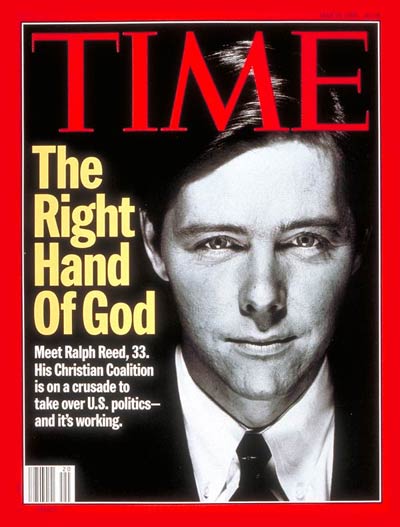
Time Magazine cover boy in 1995:

The New Hampshire senate, which usually deigns to listen only to would-be Presidents, paid close attention to his message. The ranks of conservative Christians, Reed said, are now “too large, too diverse, too significant to be ignored by either major political party.” Not long ago, America’s Christian right was dismissed as a group of pasty-faced zealots, led by divisive televangelists like Jerry Falwell, who helped yank the Republican Party so far to the right that moderates were frightened away. But Reed has emerged as the movement’s fresh face, the choirboy to the rescue, a born-again Christian with a fine sense of the secular mechanics of American politics. His message, emphasizing such broadly appealing themes as support for tax cuts, has helped make the Christian Coalition one of the most powerful grass-roots organizations in American politics. Its 1.6 million active supporters and $25 million annual budget, up from 500,000 activists and a $14.8 million budget just two years ago, hold a virtual veto on the Republican nominee for President, and will exert an extraordinary influence over who will occupy the Oval Office beginning in 1997.

To this:

(Abramoff is the one furthest to the left wearing the black shirt and baseball cap. Reed is the one to Abramoff’s immediate left, wearing khakis and a long sleeve shirt.)
From the Washington Post:

[Abramoff] looked to Reed, the former Christian Coalition leader who operated several consulting companies. Reed has acknowledged receiving as much as $4 million from Abramoff and his associate, Scanlon, to organize grass-roots anti-gambling campaigns in Louisiana and Texas. The money came from casino-rich Indian tribes, including the Coushattas, but Reed said that although he knew of Abramoff’s connection to the tribes, he did not know until media accounts surfaced last summer that his fees came from gambling proceeds.

Reed then turned to Dobson to marshal his vast network of evangelicals, Abramoff’s e-mails show.

If you thought that arrangement sounded bad, their own words in e-mails obtained by investigators and the press make it sound even worse. Again, from the Washington Post (emphasis is mine):

Among those e-mails was one from Reed to Abramoff in late 1998: “I need to start humping in corporate accounts! . . . I’m counting on you to help me with some contacts.” Within months, Abramoff hired him to lobby on behalf of the Mississippi Band of Choctaws, who were seeking to prevent competitors from setting up facilities in nearby Alabama.

In 1999, Reed e-mailed Abramoff after submitting a bill for $120,000 and warning that he would need as much as $300,000 more: “We are opening the bomb bays and holding nothing back.”

In 2004, when the casino payments to Reed were disclosed, Reed issued a statement declaring “no direct knowledge of their [Abramoff’s law firm’s] clients or interests.” In 2005, however, Senate investigators released a 1999 e-mail from Abramoff to Reed explicitly citing the client: “It would be really helpful if you could get me invoices [for services performed] as soon as possible so I can get Choctaw to get us checks ASAP.”

One of the most damaging e-mails was sent by Abramoff to partner Michael Scanlon, complaining about Reed’s billing practices and expenditure claims: “He is a bad version of us! No more money for him.” Scanlon and Abramoff have pleaded guilty to defrauding clients.

And finally to this:
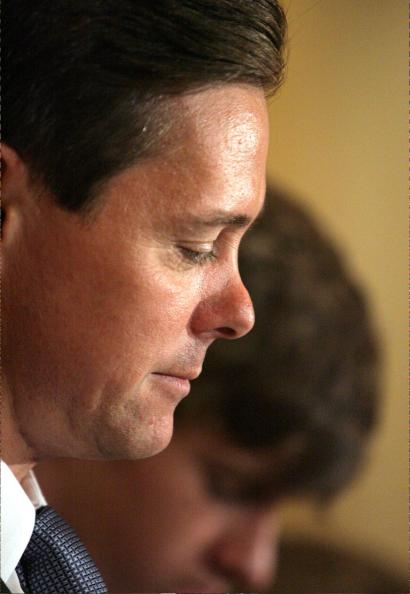
(Photo from the Atlanta Journal-Constitution)

I recommend reading the entire AJC article linked above, but here’s a key passage:

Reed often blamed “the liberal media” for focusing on the his dealings with Abramoff, but in fact many evangelical Christians were also disaffected.

Clint Austin of Marietta is a former Reed employee who ran Reed’s successful bid to become state Republican Party chairman in 2001. On Monday, Austin, now a state Capitol lobbyist, posted on the Internet an article in which he explained why he would not vote for Reed.

“My reason for abandoning my support of Ralph is simple: Ralph Reed’s words and actions do not match up,” Austin wrote.

I’d say Tom DeLay was the first political victim of the Abramoff scandal, but he decided to abandon his re-election effort instead of sticking around to run against Nick Lampson. Both Texas state parties are awaiting a ruling by the Fifth Circuit Court of Appeals to see whether they will uphold or overturn the ruling by U.S. District Judge Sam Sparks earlier this month forcing DeLay back in the race. However, DeLay has additional problems with the ongoing investigation by DA Ronnie Earle in Austin, so his legal and political problems weren’t only Abramoff-related.

How this will bode for other Abramoff-tainted lawmakers (i.e. Bob Ney, Conrad Burns) remains to be seen, but since the Washington Post reported the first Abramoff story back in 2004 and kept revealing more about his lobbying scheme, the name Abramoff has become politically radioactive in DC. Whether this will matter to their constituents back home when both men are up for re-election in November, we’ll have to keep watching both races as well as any further revelations from Abramoff-related investigations by the government and the media.

For further reference material, check out this section of the Washington Post archiving all of its Abramoff stories, for which they won a Pulitzer Prize.
I suspected this was going to happen, but this AP report confirms it.

Gore/Lieberman was such an odd pairing to go to Hollywood and ask for their money and support, given their well-documented criticisms of the entertainment industry. I think what happened in 2000 was that a lot of the Hollywood scene either held their breath and voted for Gore/Lieberman in spite of whatever disagreements they might have had with either of them (i.e. Barbra Streisand, Paul Newman), or got behind Ralph Nader (i.e. Tim Robbins, Michael Moore).

Given their criticism of the entertainment industry, I was assuming that if Gore/Lieberman got elected, that the PMRC was going to move into the West Wing. Given the well-documented dislike of President Bush in the entertainment industry, and his post-election political moves to the left on issues like Iraq, Gore has endeared himself to the Hollywood crowd. Lieberman has continued to be his usual self, and hasn’t made any friends in Hollywood by supporting the Iraq war.

Blowback

Posted: July 18, 2006 in 2006 Elections, National Security

Be careful where you point those…

Previously, I mentioned as one example the recent Mike DeWine campaign ad attacking Sherrod Brown’s national security credentials which used images of a burning World Trade Center.

The Hotline has the rebuttal ad from the Ohio Democratic Party.

At one point, the voiceover says Senator DeWine “failed us on the Intelligence Committee before 9/11 and on weapons of mass destruction.”

Maybe somebody should tell the Ohio Democratic Party that there are Democrats on the Intelligence Committee as well? How was their performance before 9/11 and on weapons of mass destruction any better?

“Would I lie to you?”
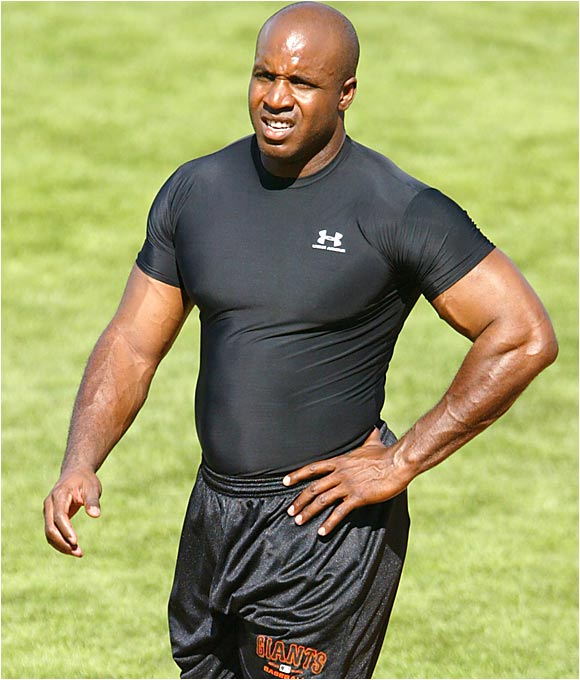
Photo from AP/Sports Illustrated.

The Washington Post is reporting that Major League Baseball is weighing possible courses of disciplinary action to take against San Francisco Giants slugger Barry Bonds if he is indicted by a federal grand jury on potential tax evasion, money laundering, and/or perjury charges.

Anyone who knows the American legal system will tell you that Bonds is innocent until proven guilty, and an indictment in and of itself is not an admission or conviction of wrongdoing on Bonds’ part.

The Post cites an anonymous source saying that he believes MLB Commissioner Bud Selig “believes he may be empowered by baseball’s collective bargaining agreement to suspend him.” They also cite another anonymous source saying that because of a mechanism in the collective bargaining agreement where players can challenge a suspension, “Bonds, with the union’s backing, almost certainly would file a grievance in this case, according to a source familiar with the union’s discussions.”

The Post also points out “No precedent is known to exist for an athlete to be suspended successfully following an indictment.”

Regardless of whether Bonds is or is not indicted, or if he is conclusively proven innocent or guilty of any of the accusations, his personal and professional reputation might as well be flushed down the toilet. Even if he breaks Hank Aaron’s home run record, I think the fans, media, and his peers will either consciously or subconsciously view the accomplishment with a giant asterisk.

There will always be questions of whether or not he was on performance enhancing drugs while he was in his home run-hitting heyday, and those questions will continue to swirl around him for the rest of his career, if not his life. Want proof? Exhibit A: Mark McGwire.

As a witness during last spring’s baseball steroids abuse hearing by the House Government Reform Committee, McGwire destroyed his own reputation and legacy through comments like these in his opening statement:

“Asking me or any other player to answer questions about who took steroids in front of television cameras will not solve the problem. If a player answers no, he simply will not be believed. If a player answers yes, he risks public scorn and endless government investigations. My lawyers have advised me that I cannot answer these questions without jeopardizing my friends, my family and myself. I intend to follow their advice.”

His response to a question by Rep. Elijah Cummings (D-Maryland) on whether he would plead the Fifth Amendment to avoid self-incrimination:

“I’m not here to talk about the past. I’m here to be positive about this subject.”

His response to other questions from the Committee, as reported by CBS News:

Asked whether use of steroids was cheating, McGwire said: “That’s not for me to determine.”

To a couple of other questions, all he would say is: “I’m retired.”

Don’t forget about Rafael Palmeiro, whose Clinton-esque “I did not have sexual relations with that steroid” denial in his opening statement resulted in the Committee investigating him for possibly lying under oath.

As a final observation, I think it would be safe to say Bonds should consider himself lucky that he wasn’t subpoenaed to testify at the steroids hearing last year. Regardless of what does or does not happen, Bonds is undergoing a PR death by a thousand cuts, and unless he does something drastic to change public perception of him and try to improve his image, he’s screwed in the court of public opinion.

All My Sins Remembered

Posted: July 17, 2006 in 2006 Elections

“Lamont, in thy candidacy be all my sins remembered.”
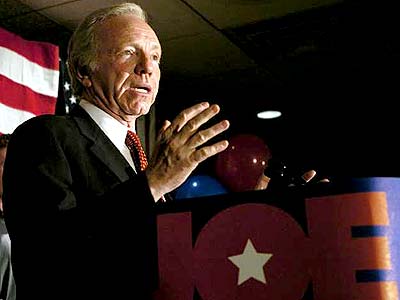
Photo from the Associated Press/LA Times/Hartford Courant

Following up on the challenge to Joe Lieberman in the Connecticut primary, I was doing some reading in several newspaper accounts. While most of them seem to mention Lieberman’s unwavering support of the Iraq war as the reason that he is the target of liberal bloggers, I did some digging at several prominent liberal blogs who are leading the opposition to Lieberman. While the war is a big issue with all of them, each have their own axe to grind with Lieberman, over less publicized issues than Iraq, some of which I didn’t even know about until I started looking into this.

Before I continue this post, in the interest of full disclosure I have no personal interest nor political affiliation for or against Ned Lamont, Joe Lieberman, or Alan Schlesinger. I have no ties or past residency to the state of Connecticut either. I’m writing on this purely as an outside observer looking in.

Rather than write about each issue myself, I will link to a different bloggers’ comments on the issues where they criticize Lieberman’s record.

Terri Schiavo.
Abu Ghraib, Clinton impeachment, and confirmation of Alberto Gonzales.

Defending President Bush from Democratic critics over the Iraq war.

Voting against the Senate Democrats’ filibuster of Samuel Alito.
Emergency contraception/reproductive rights issues.
Social Security.
His mild-mannered performance during the 2000 vice presidential debate against Dick Cheney, compared to his aggressive tone during the recent debate with Ned Lamont.

I don’t think any of these issues individually would be enough to propel a serious challenger to Lieberman or any longtime incumbent. However, as I said a few days earlier, in Lieberman’s case unfortunately for him, he happens to represent a liberal, solidly blue state in New England. His positions on the issues I’ve linked to in this post, as highlighted by partisan bloggers working for his defeat, do not help to endear him with partisan liberal Democrats who tend to come out and vote in low turnout primary contests during congressional midterm elections.

Hartford Courant columnist Paul Bass went through the skeletons in Lieberman’s closet.

The Hotline’s Chuck Todd nailed it as best as any political reporter I’ve seen, getting right to the heart of Lieberman’s problems and all of the issues that are fueling the Ned Lamont insurgency in this column from last week.

First and foremost, Lieberman’s problems aren’t all about Iraq.

His unwavering support for President Bush on Iraq was simply the tipping point. If this was just about Iraq, then many of the rank-and-file Democratic activists who are supporting Lamont would be biting their tongues on Iraq and sticking with Lieberman. The “Iraq” in this equation has been oversimplified.

Lieberman has been living on the edge with the party’s base for some time, beginning with his “sermon on the mount” critique of former President Bill Clinton during the Monica Lewinsky mess. During the 2000 campaign, there were two moments many Democrats won’t ever forget involving Lieberman: (1) his overly nice-guy approach toward Dick Cheney in the vice presidential debate; and (2) when he went against Al Gore’s legal team in regards to the rules involving military ballots.

Individually, these moments were painted positively by the press, and they added to Lieberman’s reputation as a different kind of politician.

But, taken in total, these deviations from the party paint a picture of Lieberman as a “me-first” politician to the extreme. (I say “extreme” because all politicians are “me-first” to a point.) In short, many Democrats believe Lieberman has built his national reputation by contrasting himself in a positive light against rank-and-file party members. It’s not dissimilar to what some conservatives have charged Rhode Island Republican Sen. Lincoln Chafee with doing over the years. It’s one thing to be a conservative Democrat; it’s another thing to enhance that image by trashing parts of the party to which you purport to belong.

I would be remiss if I didn’t mention the tactical blunders by Lieberman and/or his campaign operatives. The key one to me is his decision to try to get on the November ballot as a petitioning third party candidate if he loses the Democratic nomination in the August primary vote. Chuck Todd writes about it in the same column:

Frankly, Lieberman’s decision to prepare a backup plan may undermine his own cause in the primary. Think about Lamont’s main grievance against Lieberman: that the incumbent is not a real Democrat. By prepping an indepedent run, Lieberman is proving Lamont’s charge true. What message is Lieberman sending other than “When the going gets tough, the tough get going right out of the Democratic Party”? Remember Gore’s critique of Bill Bradley in the 2000 Democratic primary that the former New Jersey senator didn’t “stay and fight”? The same charge certainly applies here.

Lieberman appears to be making strategic decisions out of anger. He’s clearly irked that he’s become the liberal wing’s whipping boy. Considering some of the venom that’s being spewed at him, he can get sympathy on a personal level. But Lieberman has prided himself on not being an angry pol, and that he is somehow different from “regular” politicians.

Well, sour-grape independent candidacies are run by angry pols. And frankly, if you are a Lieberman supporter, don’t get too confident that your man can win a three-way race as an independent.

In closing, I’ll say again that there’s no one single issue that’s driving the liberal bloggers and the Lamont campaign. It would be very difficult, if not impossible, for a political novice like Ned Lamont to challenge or defeat a veteran three term incumbent like Joe Lieberman only on the basis of one issue. Lieberman has burned his bridges with the Democratic base on a lot of issues over the years, and as I said a few days ago, now everyone who’s ever had an axe to grind with him is coming out of the woodwork.

Update: Atrios wrote an op-ed on this for the LA Times.

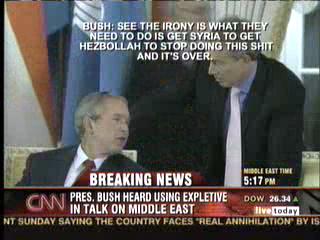
Screenshot from CNN, image from ThinkProgress.

President Bush and British Prime Minister Tony Blair had a rather interesting and candid exchange over how to resolve the current escalation of violence in the Middle East. Unfortunately for them, it appears that they didn’t know they were on camera or that the microphone nearby was on and was picking up every word.

Take a look.

Sky News has a full transcript of the conversation.

Name Change

Posted: July 17, 2006 in Uncategorized

DeBloga is dead. Sorry Adam.

The new name for this blog will be Future Unwritten. I got the name from the liner notes of The Clash’s 1982 album “Combat Rock.” The graphic in this posting is the only image I could find of it on the web through Google image search, and unfortunately it’s small and you can’t really make out the writing if you don’t know what it is. On the left side of the page in the book is the phrase “The Future Is Unwritten.” Underneath it is a banner furling over the bottom two corners of the star which reads “Know Your Rights,” which is the name of the first song on the album.

The name has absolutely nothing to do with that damn song that keeps getting played to death on pop/adult top 40 radio.

In the interest of full disclosure: I’m a huge Clash fan. “London Calling” is one of my favorite albums of all time. If you look back at this post, I took the title from the Clash song of the same name on the “Combat Rock” album. While I’m at it, I might as well plug “Westway to the World,” an excellent documentary about the Clash that came out a few years ago.

What does it mean to me and why name the blog after it? To sum it up in a word, it means possibilities. That word also happens to adequately and concisely summarize the next two years of my life as a grad student at USC.

As a journalist, it also means to me that my and our collective responsibility as a profession is never done, that we have to continuously documenting what is happening in the world.

As a history major in my undergraduate years, it also means that you have to continuously look at and reevaluate the past to better understand your present and future, either to uncover things which were missed previously or to provide a greater understanding of the present situation by understanding the context and cause and effect of how you got to where you are at this present moment.

All of those things to me are what journalism and blogging should be about, and are embodied by that simple but memorable phrase from a 24-year old album by one of the greatest and most influential punk rock bands of all time.

So update your bookmarks, the new place to go is http://future-unwritten.blogspot.com

Novak vs. Harlow

Posted: July 16, 2006 in Beltway Drama

Following up on my Wilson/Plame lawsuit posting from a few days ago, in which I said I would go into further detail on the discrepancies between Bob Novak and ex-CIA spokesman Bill Harlow’s recollections of their conversations about Joe Wilson and Valerie Plame prior to the publication of Novak’s now infamous July 14, 2003 column which outed her.

The whole dispute began in earnest last summer when the Washington Post ran a front page story in which they interviewed Harlow.

Harlow, the former CIA spokesman, said in an interview yesterday that he testified last year before a grand jury about conversations he had with Novak at least three days before the column was published. He said he warned Novak, in the strongest terms he was permitted to use without revealing classified information, that Wilson’s wife had not authorized the mission and that if he did write about it, her name should not be revealed.

Harlow said that after Novak’s call, he checked Plame’s status and confirmed that she was an undercover operative. He said he called Novak back to repeat that the story Novak had related to him was wrong and that Plame’s name should not be used. But he did not tell Novak directly that she was undercover because that was classified.

After months of publicly refusing to answer questions about the leak case and his role in it, Novak felt obliged to respond to Harlow’s claims four days after the Washington Post ran its story.

Harlow said to the Post that he did not tell me Mrs. Wilson “was undercover because that was classified.” What he did say was, as I reported in a previous column, “she probably never again would be given a foreign assignment but that exposure of her name might cause ‘difficulties.'” According to CIA sources, she was brought home from foreign assignments in 1997, when Agency officials feared she had been “outed” by the traitor Aldrich Ames.

I have previously said that I never would have written those sentences if Bill Harlow, then CIA Director George Tenet or anybody else from the Agency had told me that Valerie Plame Wilson’s disclosure would endanger herself or anybody.

A few days later, he was on CNN’s “Inside Politics” where anchor Ed Henry was about to question him about the Plame leak, and a seemingly harmless exchange with James Carville over Katherine Harris in the Florida Senate race led to this classic television moment.

NYU journalism professor Jay Rosen offered what I think is the best analysis of the whole incident. You can read his take on it here.

Fast forward nearly a year later, Novak writes another column, outlining his role in the investigation and again taking issue with Harlow, whom he identifies as one of his three sources for the story.

In the second to last paragraph, Novak writes

Following my interview with the primary source, I sought out the second administration official and the CIA spokesman for confirmation. I learned Valerie Plame’s name from Joe Wilson’s entry in “Who’s Who in America.”

However, even before the Novak-Harlow pissing match which began last year, there are more questions about what Novak knew, when he knew it, and who told him.

In 2004, Joe Wilson’s book “The Politics of Truth” was published. The book was mostly a memoir of his life in government service, but the parts everyone was interested in reading about of course was about the Plame leak.

I would recommend reading all of Chapter 17 (“A Strange Encounter with Robert Novak”) but for those who don’t have the book, the short version is that on July 8, 2003, six days before Novak’s column is published, an unidentified friend of Wilson’s tells him that he had run into Novak walking down Pennsylvania Avenue. He struck up a conversation with Novak on the uranium controversy and asked for his opinion of Wilson, and Novak (not knowing that this man was a friend of Wilson’s) responded, “Wilson’s an asshole. The CIA sent him. His wife, Valerie, works for the CIA. She’s a weapons of mass destruction specialist. She sent him.” Novak and Wilson’s friend went their separate ways, and Wilson’s friend went straight to Wilson’s office to tell him the story.

Wilson writes that he called then-CNN executive Eason Jordan and relayed the story to him, and asked him to speak to Novak on his behalf. Jordan eventually arranged for a phone call between Novak and Wilson. The phone call eventually happened two days later, on July 10. This is how Wilson describes it in page 344 of his book:

He listened quietly as I repeated to him my friend’s account of their conversation. I told him I couldn’t imagine what had possessed him to blurt out to a complete stranger what he had thought he knew about my wife.

Novak apologized, and then asked if I would confirm what he had heard from a CIA source: that my wife worked at the Agency. I told him that I didn’t answer questions about my wife. I told him that my story was not about my wife or even about me; it was about sixteen words in the State of the Union address.

On page 345, he describes his reaction to the July 14 Novak column:

Amid the welter of emotions I felt that morning, I tried to understand a particular element of Novak’s story.
He cited not a CIA source, as he had indicated on the phone four days earlier, but rather two senior administration sources; I called him for a clarification. He asked if I was very displeased with the article, and I replied that I did not see what the mention of my wife had added to it but that the reason for my call was to question his sources. When we first spoke, he had cited to me a CIA source, yet his published story cited two senior administration sources. He replied: “I misspoke the first time we talked.”

Wilson elaborates on some of the steps he and his wife took to try to protect her name from coming out once they knew Novak had the information:

A couple of days before Novak’s article was published, but after my friend’s strange encounter with him, I had received a call from [Washington] Post reporter Walter Pincus, who alerted me that “they are coming after you.” Since I already knew what Novak had learned about Valerie, I was increasingly concerned over what else might be put out abotu her. I assumed, though, that the CIA would itself quash any article that made reference to Valerie… Novak had still been trolling for sources when we spoke on the telephone, so I assumed that he did not have the confirmations he would need from the CIA to publish the story. I told Valerie, who alerted the press liaison at the CIA, and we were left with the reasonable expectation that any reference to her would be dropped, since he would have no way of confirming the information – unless, of course, he got confirmations from another part of the government, such as the White House.

Novak has now admitted to having three sources, including Harlow at CIA. He spoke to Wilson’s friend on July 8, the same day he spoke to Karl Rove as his confirming second source, according to a story in the New York Times last summer. He may very well have misspoken when he first talked to Wilson on July 10, attributing his info about Plame to a CIA source. However, given that his CIA source for this story was Bill Harlow, and Harlow is saying something different, I’m wondering if it’s possible to reconcile these two versions or not. Or Harlow may have inadvertently confirmed the Plame info before he knew it would be a hot potato or that it was classified information. What we still don’t know yet is when Novak spoke to Harlow – was it before his July 8 conversations with Rove and Wilson’s friend, after July 8 but before his July 10 conversation with Wilson, or after July 10 and before July 14 when his column was published?

Curiously enough, even though it has nothing to do with this subject, on July 8, Scooter Libby was meeting with New York Times reporter Judy Miller at the St. Regis Hotel in Washington DC, during which Valerie Plame was discussed. This was first reported by investigative journalist Murray Waas in the American Prospect in August of 2005, before it was subsequently confirmed by the Washington Post in September of 2005, and ultimately confirmed by Judy Miller herself in the pages of the New York Times.

Back to Novak and Harlow, Murray Waas reported for the American Prospect in February 2004:

Two government officials have told the FBI that conservative columnist Robert Novak was asked specifically not to publish the name of undercover CIA operative Valerie Plame in his now-famous July 14 newspaper column. The two officials told investigators they warned Novak that by naming Plame he might potentially jeopardize her ability to engage in covert work, stymie ongoing intelligence operations, and jeopardize sensitive overseas sources.

The two administration officials questioned by the FBI characterized Novak’s statements as untrue and misleading, according to a government official and an attorney official familiar with the FBI interviews.

The two officials say Novak was told, as one source put it, that Plame’s work for the CIA “went much further than her being an analyst,” and that publishing her name would be “hurtful” and could stymie ongoing intelligence operations and jeopardize her overseas sources.

“When [Novak] says that he was not told that he was ‘endangering’ someone, that statement might be technically true,” this source says. “Nobody directly told him that she was going to be physically hurt. But that was implicit in that he was told what she did for a living.”

“At best, he is parsing words,” said the other official. “At worst, he is lying to his readers and the public. Journalists should not lie, I would think.” These new accounts, provided by two sources familiar to the investigation, contradict Novak’s attempts to downplay his own knowledge about the potential harm to Plame.

Moreover, one of the government officials who has told federal investigators that Novak’s account is false has also turned over to investigators contemporaneous notes he made of at least one conversation with Novak. Those notes, according to sources, appear to corroborate the official’s version of events.

If this account is correct, I would guess that one of the officials in Waas’ article is Harlow. If Novak did lie to investigators, that would be stupid and reckless on his part. On the other hand, if the FBI or Patrick Fitzgerald had the evidence to prove it, I’m sure they would have gone for an indictment against Novak.

Novak and Harlow’s versions of the story are complete opposites. Unless we find out more details in a Fitzgerald document filing or during a court hearing, or the Wilson lawsuit is allowed to proceed and Wilson’s legal team puts Novak and Harlow on the witness stand and start questioning them under oath, we may never know whose version is accurate.

The questions that Novak and Harlow need to answer to settle this:

1) When did Novak find out about Plame’s CIA employment?
2) When did he contact Harlow or the CIA Public Affairs Office for confirmation? How does the timing of that conversation match up with other events happening during that time period?
3) How strongly was he warned or discouraged (if at all) about using Plame’s name by Harlow or others?
4) Did Novak ignore the warnings and do it anyway?
5) Did Novak subsequently lie about it in public comments? Or is Harlow lying about trying to warn off Novak because he didn’t want to admit as a confirming source he had passed on classified information?

Photo from the Missouri Civil War Museum.

This topic is brought up because of the recent Republican uproar over an ad by the Democratic Congressional Campaign Committee which used an image of a flag draped caskets of soldiers killed in Iraq. You can view the ad here.

I personally don’t believe in using any images of dead in ads for any political purpose because they have no way of speaking out for themselves. If I were a media consultant for a candidate or campaign, I wouldn’t touch the dead or their relatives in any of my ads with a proverbial twenty foot pole. In my view it cheapens the discourse by trying to shamelessly and overtly exploit someone else’s tragedy to score political points.

Unfortunately, the DCCC ad is hardly the first, and only use of dead people for a political statement, by the Republicans or the Democrats in this election cycle or previous ones.

Republican Senator Mike DeWine’s re-eelection campaign recently made an ad attacking his opponent Sherrod Brown’s national security credentials. The ad uses an image of a burning World Trade Center on 9/11. Unfortunately, I’ve been unable to find the ad online, so I can only link to this article from the Columbus Dispatch.

In 2004, President Bush’s first re-election ad briefly showed images of the World Trade Center rubble a flag-covered body being moved from Ground Zero.

Fast forward a few months later, Democratic presidential nominee John Kerry obtained the endorsement of “the Jersey Girls,” four 9/11 widows who lobbied for the creation of the 9/11 Commission and reforms of the intelligence and homeland security community, and immediately put one of them in an ad and had them hit the campaign trail for him. I can’t find the ad online, so you’ll have to settle with the written account from Fox News that I linked to.

At the same time, Progress for America, a conservative 527 group, did this emotionally wrenching ad of President Bush’s meeting with a little girl from Ohio whose mother was killed in the World Trade Center. According to Fox News, this was the biggest single political ad buy in history, worth $17 million.

But you have to go waaaaay back to the 1944 presidential election campaign, in the middle of World War II, when President Franklin Delano Roosevelt had “I Remember Pearl Harbor” buttons made for his re-election campaign for a fourth term. Unfortunately I haven’t been able to find any images of the buttons themselves online, only written references to them. If I do find it later, I will update this posting to include a link or image.

Neither party can or should claim a higher sense of morality or outrage for using images of dead people or their families for political purposes. As far as I can tell they are both equally shameless and opportunistic on this subject.

Selective Editing

Posted: July 15, 2006 in Humor

The guys who put together the hilarious Brokeback to the Future parody trailer have decided to take a stab at the new X-Men movie.

Take a look.