Archive for the ‘Barack Obama’ Category

McCain senior advisor Steve Schmidt on September 22:

Whatever the New York Times once was, it is today, not by any standard a journalistic organization. It is a pro-Obama advocacy organization that every day attacks the McCain Campaign, attacks Senator McCain, attacks Governor Palin, and excuses Senator Obama,” said Schmidt.

Schmidt, who has been forced to steadily raise the volume on attention-getting ads and statements like this one, as they become daily fodder, called the Times “completely, totally, 150 percent in the tank for the Democratic candidate.”

The Republican National Committee on October 4:

The New York Times Sheds Additional Light On The Relationship Between Obama And Terrorist Bill Ayers

The New York Times Found That Obama Has Tried To Play Down His Contacts With Bill Ayers

Ayers Is A Former Left-Wing Activist And Leader Of The Weather Underground, A Radical Group Responsible For Multiple U.S. Bombings

Update Vice presidential candidate Sarah Palin on October 6:

Worse, Palin’s routine attacks on the media have begun to spill into ugliness. In Clearwater, arriving reporters were greeted with shouts and taunts by the crowd of about 3,000. Palin then went on to blame Katie Couric’s questions for her “less-than-successful interview with kinda mainstream media.” At that, Palin supporters turned on reporters in the press area, waving thunder sticks and shouting abuse. Others hurled obscenities at a camera crew. One Palin supporter shouted a racial epithet at an African American sound man for a network and told him, “Sit down, boy.”

Karl Rove has launched a website. As if you needed more tea leaves that McCain was in trouble, the most prominent Republican strategist of his generation is projecting an Obama win in his analysis of the Electoral College map a month out from Election Day.

Separately, this Politico article points out the pressure the McCain campaign is under to defend Virginia, which has voted Republican in every presidential election since 1964. But it also looks at the national map as a whole, and how the unfriendly dynamics of the race are forcing the McCain campaign to adjust in the final stretch:

Beyond the financial implications of that approach, the GOP ticket is confronting new demands on its time. The McCain campaign would prefer to have the Arizona senator and Alaska governor campaign together, but they are now being forced to protect more states so they may have to spend more time apart.

It’s a akin to a campaign version of whack-a-mole, where finite time and money is being spread across the landscape to defend against sudden and unexpected Democratic surges on GOP turf.

Not good omens for the GOP with less than a month to go before the election.

48 out of 50 states allocate their Electoral College votes on a winner-take-all basis. For example, whichever candidate wins a majority of the votes in Florida, he would get all of the state’s 27 votes.

The two states that are the exception to this rule are Maine and Nebraska, who allocate their Electoral College votes (5 in Nebraska, 4 in Maine) on the basis of their congressional districts (3 in Nebraska, 2 in Maine). Both states are reliably Republican or Democratic in presidential and but have bipartisan leanings when it comes to statewide elections.

Late in the race, two new battlegrounds have opened up. The 2nd congressional district in Nebraska (which includes Omaha), and the 2nd congressional district in Maine, which is predominantly rural. Both are worth 1 Electoral College vote apiece, and in a 269-269 scenario, where both sides tied with one vote shy of winning the presidency, either district could make or break the two campaigns.

There are two articles worth pointing out. The first, from the Omaha World-Herald:

In another sign that Nebraska’s 2nd Congressional District is in play in the race for the White House, Republican vice presidential candidate Sarah Palin will speak at a public rally tonight in Omaha.

It’s rare for a member of the national ticket in either party to visit traditionally Republican Nebraska this late in a presidential campaign. Obama drew about 10,000 people to an Omaha rally in February. GOP nominee John McCain was in Ashland, Neb., for a fundraiser in July.

First, the fact that they are even contemplating the possibility of McCain losing an Electoral College vote in Nebraska would have been unthinkable at this time last year, let alone in previous presidential elections where the GOP candidate swept all of the state’s votes. Second, the fact that the McCain campaign finds it necessary to send Palin to hold a rally there this late in the game, when they should be focusing their efforts on the swing states that will decide the election is NOT a good sign. This is especially important in light of McCain’s decision to concede Michigan a month before the election, which narrows his options on the map to hit 270.

The second article, on McCain’s efforts to win an Electoral College vote in Maine, from the Associated Press:

PORTLAND, Maine—With a moose-hunting hockey mom sharing the ticket, Republican John McCain plans to make a greater push in this state that has gone blue in recent elections but shares Sarah Palin’s embrace of hunting, snowmobiling and the outdoors.

McCain’s presidential campaign indicated it would put more resources into Maine as it decided to pull out of Michigan and cede that state to Democrat Barack Obama.

Of particular interest is Maine’s 2nd Congressional District, the largest east of the Mississippi, where Palin is more likely to find kindred spirits in the state’s rural north. The vast expanse of lakes, forests and coast may remind her of Alaska, where she serves as governor.

Finally, there’s the possibility of splitting Maine’s four electoral votes. The state awards two to the statewide winner and one to the winner of each of the two congressional districts. In a close race nationally, Republicans can’t afford to write off the one electoral vote from residents of the state’s rugged north.

Maine’s 2nd district mirrors rural Alaska in some ways. Favorite pastimes include hunting, fishing and snowmobiling. Palin’s husband is a snowmobile racer and commercial fisherman, and a video of Palin attests to her ability to field dress a moose.

First, the idea that they might win Maine because of some common elements with Alaska on the environment and hunting and snowmobiling is ridiculous on its face. This is from the same logic playbook that Palin has foreign policy experience because of Alaska’s proximity to Russia.

Second, Maine has a long history of voting for moderate Republicans. Both of the state’s current senators are Republican women. William Cohen is another example. Sarah Palin is a red-meat conservative Republican on everything – social issues, the economy, foreign policy, etc. While McCain may have some crossover appeal here because of the quirky libertarian streak that runs through parts of New England (especially in neighboring New Hampshire, which McCain won in 2000 and 2008), that does not mean it will automatically transfer to Sarah Palin.

The Obama campaign would be guilty of political malpractice if they took this district for granted, and according to the article, they have 30 offices in the state to promote their candidate. But the biggest question I have is why is the McCain campaign spending time, energy, and resources in Maine?

Ultimately, I think both campaigns’ posturing essentially amount to a paper tiger strategy, projecting an image of competitiveness on the other guy’s turf to force him to spend money and resources on defense. Both states and their votes will probably fall in line with historical trends – Nebraska for the GOP, Maine for the Democrats – but Obama has more resources to work with and as of this writing, a friendlier political environment and a bigger map to reach 270.

Politico’s Jonathan Martin gets the scoop of the day, as if the media talking heads and political operatives weren’t already aflutter because of the VP debate tonight.  McCain has thrown in the towel on any hopes of winning Michigan next month.  Staffers and resources are being relocated to Wisconsin, Ohio and Florida.

This is significant because Michigan was one of the Kerry states McCain had a shot at winning (the other being New Hampshire), as well as his win here during the 2000 GOP primaries.  He lost to Mitt Romney the second time around.

Obama has gained momentum and opened up a lead in state and national polls against McCain.  He’s even forcing McCain to play defense in Indiana and Virginia, which were solid GOP states for more than 40 years.

The pressure is on McCain in two ways.  First, he’s financially boxed in by accepting public financing, so he only has $84 million to spend for the last 2 months of the race.  If the Obama fundraising juggernaut can keep up its pace, they could force McCain to make some very tough choices in the final stretch about where and how to allocate personnel, resources, and money.

Second, by conceding Michigan it raises the stakes for McCain to win in Pennsylvania, Florida, and Ohio.  If he loses Pennsylvania, he MUST hang on to Florida and Ohio and hope he can run up an Electoral College lead elsewhere.  If he loses all three, it’s game over.

This is the first in a series I will be doing every week from now until Election Day. The following map shows the race as it stands right now, and divides the 50 states into three categories: McCain (Red), Obama (Blue), and Swing (Yellow).


I’ve allocated states for John McCain and Barack Obama based on traditional and current voting trends and demographics. As always, the swing states – by my count, the 16 states which can go in favor of either candidate on Election Day – will determine which candidate wins the White House in November. The magic number of Electoral College votes needed to win the presidency is 270, hence the title of this entry.

A brief observation about the 16 swing states in this year’s race: many of them are perennially up for grabs in presidential elections, among them three of the biggest prizes up for grabs: Florida, Pennsylvania and Ohio. Their importance cannot be overestimated: two of these states have ultimately decided the winner of the last two presidential elections.

But what makes this year unusual is that the GOP is forced to play defense in three states that have been reliably Republican for decades: North Carolina, which hasn’t gone to a Democrat since Jimmy Carter’s 1976 campaign; and Virginia and Indiana, which were last won by Lyndon Johnson during his 1964 landslide victory. John Kerry made an attempt to pick up Virginia and North Carolina (the home state of his running mate John Edwards) four years ago, but ultimately gave up when poll numbers showed both states to be out of reach.

Montana is also a remote possibility as a swing state, although recent polls have the state leaning toward McCain. But the Democrats have had a bit of a resurgence at the state level in recent years. Historically, Bill Clinton won the state back in 1992, but he had help from Ross Perot, who siphoned off votes that might have otherwise gone to the incumbent president George H.W. Bush. George W. Bush routed Al Gore and John Kerry in Montana by 25 and 20 points respectively in his two presidential campaigns.

With the exception of these four states, the swing state map is virtually identical to 2004. In contrast, there are no solidly Democratic states (i.e. Massachusetts, Washington) that are up for grabs the way that Virginia, North Carolina, Indiana, and (to a lesser degree) Montana are now.

Based on recent trends and analysis, here’s what the map would look like if the election were held the week of September 29:
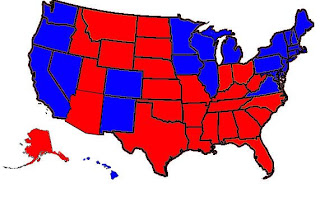

Barack Obama would win the election 291-247, with a majority of the swing states breaking in his favor. There are two reasons for this argument: first, James Carville’s famous line from the 1992 Clinton campaign “It’s the economy, stupid,”, second, the McCain campaign’s dizzying and near perpetual tailspin which began with the Lehman Brothers bankruptcy on September 15, which shifted the focus of the campaign from lipstick on a pig and national security – considered John McCain’s strong subject – to the economy, a subject which polls show voters prefer the Democrats.

McCain’s downward spiral has gotten progressively worse with his decision to suspend his campaign, essentially drawing against Barack Obama during the first presidential debate which helped to solidify the Democrat’s standing in the national and state polls, the failure of Congress to pass a bailout package in the House of Representatives, and the Dow Jones industrial average taking a record 777 point nosedive after the bill’s collapse.

McCain would narrowly win Florida and Ohio, two states out of the big three up for grabs that both went for George W. Bush in the last two elections. But Obama would compensate for those losses by winning Nevada, Colorado, New Mexico, and Virginia – worth a combined 32 Electoral College votes, almost enough to offset the combined loss of Ohio and Florida’s 47 Electoral College votes – while retaining all of the other states John Kerry won in 2004.

It’s a pretty safe bet that one of these states will push Obama or McCain past the 270 threshold to win the White House. If I had to pick one, based on the 2006 elections, I’d choose Virginia. It was the Webb-Allen Senate race that in the end gave the Democrats control of the U.S. Senate, and it was also the last race to be decided.

Ohio would be very close again, and the political terrain might shift in Obama’s favor compared to 2004 because of Democratic gains in the state during 2006 and because of the focus on the economy, particularly in a manufacturing state like Ohio which has been hit hard by outsourcing and unemployment. It wouldn’t be enough right now to flip to the Obama side, but McCain and the Republicans would have to spend a lot of time and money defending it, because without Ohio it would be virtually impossible for McCain to win the race.

McCain’s best chance at picking up a Kerry swing state from 2004 at this point is New Hampshire. Given the strong libertarian and independent streak in their electorate, and the fact that McCain won two critical victories in their primary in 2000 and 2008, that it is the most Republican-leaning state in New England, and that it was one of only three states (along with Iowa and New Mexico) that flipped parties between 2000 and 2004, don’t be surprised if you see him there a few times between now and November.

One thing working against him is recent political trends. When the Democrats retook control of Congress in 2006, one of the geographic areas where they made a significant amount of gains was in New England, where several incumbent moderate Republicans in the House (Nancy Johnson, Charlie Bass, etc.) and the Senate (Lincoln Chafee) were ousted. Now, there is only one House Republican from New England: Rep. Christopher Shays of Connecticut, and Sen. Susan Collins of Maine is facing a tough re-election fight.

As I said in a previous post, unless John McCain or some outside event can fundamentally shake the dynamic of the race away from Obama’s favor, it will become increasingly difficult to stop his momentum and of perceptions of undecided voters from hardening. A lot can change in a day or even a few weeks, as we’ve seen during the month of September, but time is running out for the McCain campaign.

His best hopes are either that Obama does disastrously in the final two presidential debates, or that some enterprising reporter unearths an October surprise that will damage his candidacy that could push just enough swing voters in McCain’s direction. But given that no reporter, or any opposition researcher from the Hillary Clinton campaign for that matter, was able to find a silver bullet to stop the Obama juggernaut, this is not a strategy I would plan the final weeks of a presidential campaign around.


Photo courtesy: New York Times

“Disconnect and self-destruct one bullet at a time.”
A Perfect Circle, “The Outsider”

September 15 is celebrated as Independence Day in many Latin American countries, but in U.S. political history that day might be remembered as the beginning of the end of John McCain’s presidential ambitions.

The collapse of Lehman Brothers, and the federal government bailouts of AIG, Freddie Mac and Fannie Mae completely changed the dynamic and narrative of the campaign. While mock outrage over lipstick on a pig and real issues of national security – McCain’s strong point – had been driving the media cycle and coverage, the biggest financial crisis since 1929 completely changed the playing field. And John McCain blew it.

“The fundamentals of our economy are strong,” McCain said at a campaign event the same day that the markets were going haywire. This was manna from heaven for the Democrats, who proceeded to hammer McCain mercilessly over the comment. His subsequent reversal did little to undo the minimal political damage caused by the original comment.

His decision to “suspend” his campaign will probably leave voters at large with a very unfavorable impression of him. David Letterman did him no favors either, brutally eviscerating him after finding out that McCain canceled an appearance on the Late Show – not to go back to Washington and work on the legislative bailout package as he originally claimed – but to do an interview with CBS Evening News anchor Katie Couric.

“Hey Senator, can I give you a ride home?” Letterman facetiously asked as the show took the live in-house CBS feed of McCain getting ready for the interview with Couric. This may well go down in history as a late night campaign moment, potentially up with Bill Clinton playing saxophone on the Arsenio Hall show back in 1992.

Given the influence of late night comics at reaching the electorate who may not get their dose of politics from hard news programs like the NBC Nightly News or 60 Minutes, having someone with Letterman’s influence and reach taking him out to the woodshed on a semi-regular basis won’t do McCain any favors.

Letterman continued his comedic assault on McCain a day later. “Here’s how it works: you don’t come to see me? You don’t come to see me? Well, we might not see you on Inauguration Day,” he said.

Sarah Palin’s disastrous interview with Katie Couric only served to reaffirm doubts among her critics, raise them among her supporters and the punditocracy about her qualifications to be vice president, or step in and take over for McCain in case of an emergency. Her responses to legitimate questions from Couric were a series of talking points incoherently sequenced together to make something she hoped resembled a sentence. The McCain campaign will keep her as far away from the press as possible after the vice presidential debate.

The only upside from that interview is that it has effectively set the bar so low for the vice presidential debate that it will probably be considered a success for her just for showing up and taking questions. Joe Biden doesn’t even have to attack her – all he needs to do is look and act like the elder statesman he is in answering questions, not make any gaffes, and let her dig herself into a hole before a nationally televised audience of millions.

But perhaps the biggest jumping the shark moment in this two week self-implosion was McCain boldly proposing to postpone the first presidential debate and reschedule the vice presidential debate – having been agreed to by both campaigns and the debate commission long before – unless Congress passed a bailout package.

McCain effectively boxed himself into a corner that left him with no good options. If he didn’t show up, he would effectively give Barack Obama 90 minutes of free uncontested airtime to millions of voters and anger potential voters in Mississippi, where Ole Miss had already spent more than $5 million in setting up for the debate. If he reversed himself and did show up – with or without a package ready to go – he would look like he backed down from a threat he couldn’t carry out.

During the debate, McCain said “If you’re going to aim a gun at somebody, George Shultz, our great secretary of state, told me once, you’d better be prepared to pull the trigger.” To phrase it using those terms: McCain aimed a gun at these debates, threatened to pull the trigger if Congress didn’t pass a bill, and backed down. The fact that his campaign had produced web ads proclaiming McCain won the debate, which were released before it even took place, shows McCain took the pulling the trigger option about as seriously as most political observers take Ralph Nader now.

There are five more weeks and three more debates to go between now and Election Day, and we’ve already seen how much the dynamic can change in the course of one day or one event. McCain and his surrogates (Rick Davis, Steve Schmidt, Carly Fiorina, Douglas Holtz-Eakin) have been misfiring on nearly all cylinders during the last two weeks. Unless McCain is able to fundamentally shift the dynamics of the race in his favor, or some outside event does it for him, he will spend the rest of the campaign watching his presidential ambitions slipping away.


I’ll give you 32 million reasons… (Photo courtesy: New York Times)

Wow.

Obama’s money

Campaign manager David Plouffe says he’s raised $32 million this month.

That would be more than $1 million a day.

About 18 minutes into tonight’s debate of the Democratic presidential candidates on MSNBC, Barack Obama said “In terms of how we’ve been running this campaign, I think what we’ve seen is I haven’t taken money from federal registered lobbyists. We’re not taking money from PACs.”

A review of his campaign finance numbers for the first quarter of 2007 compiled by the Washington Post shows that he has received $3,050 in PAC money.

UPDATE/CORRECTION: The FEC lists the same set of contributions as “Non-Party (e.g. PACs) or Other Committees”

A review of this section shows 5 separate contributions. Four of them are from congressional campaigns. The other is from Locke Liddell and Sapp LLP PAC, dated Feb. 21, 2007 and worth $1000.00. An image of the form for this contribution can be viewed here.