Archive for the ‘Beltway Drama’ Category

The Guardian wrote a profile on legendary investigative reporter Seymour Hersh. Yes, he does have a well-documented record of being a Bush-hating liberal who can get a little over the top with his rhetoric. But the Guardian buried the lead in their story.

‘You cannot believe how many people have told me to call them on 20 January [the date of the next president’s inauguration],’ he says, with relish. ‘[They say:] “You wanna know about abuses and violations? Call me then.” So that is what I’ll do, so long as nothing awful happens before the inauguration.’

Memo to investigative reporters everywhere: Have your rolodexes updated and ready to work the phones on Inauguration Day.

Another campaign is quietly underway, which won’t kick in to full effect until after the election. Patrick Ruffini has a short writeup on the candidates to be the next chairman of the Republican National Committee. I’ll have more on this later, but it’s a good concise overview of who’s in the running.

Regardless of whether McCain wins or loses, this will be the more interesting race regarding who takes over the leadership of the two major political parties, because it will be the next RNC chairman’s job to rebuild and redefine the Republican Party in a post-Bush era after one (and potentially two) election drubbings and put together the political infrastructure for 2010 and 2012.

ABC’s Jake Tapper has a good recap of the highlights of Powell’s interview on Meet the Press.

As I said before – this will dominate the news cycle for one or two days. Pundits in the blogosphere and the major media will be aflutter talking about this. Obama clearly controlled the narrative yesterday with the carefully timed announcement of his $150 million fundraising figure and the nod from Powell.

McCain’s problem is that he is running out of time. He has about two weeks to go and not many ways to change or control the media narrative before Election Day. Barring a drastic change in the underlying fundamental dynamic of this election (which happened when the financial crisis hit on September 15), the political environment will continue to favor Obama.

Update: Former McCain adviser Mike Murphy weighs in at TIME’s Swampland Blog. His analysis: “Colin Powell’s endorsement of Obama today is a real sledgehammer blow to the already staggering McCain campaign.” The rest of it is not pretty.

A few days ago, I made note of the back and forth sniping going on between the McCain campaign and conservative pundit Bill Kristol. It’s gotten a bit personal lately, with McCain campaign manager Rick Davis personally taking Kristol out to the woodshed on national television. The key soundbite:

DAVIS: Yes, well, you know, it’s a good thing Bill Kristol has never run a political campaign because he’d probably have to fire himself at least two or three times.

This may be beyond standard political sniping. Scott Horton of Harper’s has written extensively about Bill Kristol’s role in promoting Sarah Palin for the VP slot. But in a recent interview with Glenn Greenwald, Horton reveals evidence of discontent behind closed doors at the McCain campaign.

SH: I’d say, of course the McCain campaign isn’t doing too well right now, and one of the consequences of that is we’ve got a lot of finger-pointing going on within the camp, and I’d say there’s a pretty broad agreement amongst a number of the senior-most advisors to McCain that the Palin pick is worse than disappointing. It’s a total disaster, as one describes to me. And there is a sort of blame game going on there.

Now, one of them described to me quite recently in some detail, who it was who introduced and pushed the Palin nomination, and he says it really boils down – there were a number of people behind the nomination, but there’s one person who was essentially the person who introduced her as a candidate and pushed her consistently and firmly all through the summer primary she was elected – and that person is Bill Kristol. And the interesting thing is of course, if we look across the whole horizon of conservative columnists, prominent conservative columnists, pretty much all of them are expressing reservations or concerns or they’re outright opposing Palin as a pick, with one really striking exception, and that’s Bill Kristol. And Bill Kristol, in none of his columns has acknowledged that he in a sense is the author of Sarah Palin. He discovered her, he promoted her, and he pushed her through to the vice-presidential nomination.

If this is true, that makes Kristol’s recent criticism of Palin much more self-serving. It’s become full-on cover your ass mode. When the post-mortem of this campaign is written, there will be a lot of people pointing fingers at each other, and I think quite a few of them will be pointed at Bill Kristol.

Following up on my entry yesterday on the Democratic efforts to get a 60-seat supermajority in the Senate, Politico’s Jonathan Martin gets a scoop on last-minute GOP efforts to defend its Senate candidates from what could be a very bloody Election Day that could potentially be bigger than the Democratic tsunami of 2006.

The Republican National Committee, growing nervous over the prospect of Democrats’ winning a filibuster-proof majority in the Senate, is considering tapping into a $5 million line of credit this week to aid an increasing number of vulnerable incumbents, top Republicans say.

With party strategists fearing a bloodbath at the polls, GOP officials are shifting to triage mode, determining who can be saved and where to best spend their money.

And with the House and Senate Republican campaign committees being drastically outspent by their Democratic counterparts, and outside groups such as Freedom’s Watch offering far less help than was once anticipated, Republicans are turning to the national party committee as a lender of last resort.

A decision is imminent because television time must be reserved and paid for upfront, and available slots are dwindling.

A representative for the RNC would neither confirm nor deny that it was considering the move.

Looks like Patrick Ruffini was right in his assessment which I quoted yesterday.

Marc Ambinder does a good job of explaining the war of words between conservative pundit Bill Kristol and McCain surrogate Nancy Pfotenhauer.

While the presidential race is getting most of the press and public attention, recent developments in the political terrain have forced observers and the media to ask themselves a question that would have been thought preposterous as little as a few months ago: Can the Democrats rack up a filibuster-proof 60-seat supermajority?

It’s been fairly clear that Republicans would not be able to flip the Democratic majority in the Senate in the 2008 election, a position confirmed by the McCain campaign this past weekend when they argued in favor of the merits of divided government.

Democrats, under the helm of Charles Schumer, flipped a 6-seat deficit into a 1-seat majority in 2006 by winning every competitive race but one. This year, in an arguably more favorable political environment, they have a historic opportunity to build a lasting Senate majority through the first term of the next president.

If Obama wins the White House, it will be the first time the Democrats have controlled the White House, House of Representatives, and Senate since the first two years of Bill Clinton’s presidency, until the Gingrich Revolution of 1994. If Obama gets a Democratic supermajority in the Senate, there will be nothing Republicans can do to stall his legislative agenda or any nominations requiring Senate confirmation. The same party that advocated the nuclear option as a means of getting around Democratic obstruction of Bush judicial nominees is now looking at the very real possibility that they won’t even have the numbers to pull off a filibuster.

Patrick Ruffini writes that the Republican Party should focus their energies and resources in a handful of Senate races in order to protect a Republican filibuster as an opposition mechanism to a potential Obama presidency.

The NRSC and the NRCC, like the McCain campaign at the national level, are being buried by the Democrats’ massive financial advantage. In 2006, the RNC was able to come to the rescue of these committees. In one case, I believe one of their independent expenditures tipped the outcome with their humorous, effective, and perfectly legitimate ad against Harold Ford in Tennessee.

This time, no such help has been forthcoming in Senate races. The RNC IE unit has targeted one and only one candidate: Barack Obama, with $15 million.

Extraordinary circumstances compel us to begin considering different strategies, including a break with the RNC’s tradition as the Presidential committee in Presidential years.

The RNC’s IE unit should drop at least $15 million on 4 or 5 key Senate races that are salvageable in the last three weeks.

And the decision for Victory to stay in or pull out of states should be heavily influenced by the presence of key Senate and House contests.

And McCain should start explicitly making the argument for divided government, with him as the only hope of preserving it. This is unlikely to be a voting issue at the Presidential level, but we need to get the idea percolating that we are about to elect Obama with unchecked, unlimited power. Power corrupts… absolute power corrupts absolutely, etc.

Obama at 56 seats makes life hard, but a lot more bearable than Obama at 60 seats. The death of the filibuster would be like losing the White House all over again.

Ruffini has a point. The Democrats got their Senate majority in 2006 by squeaking out victories in Virginia and Montana by a few thousand or so votes. If Republican groups had spent a few extra dollars on ads, paid staff, or other resources in those states, Mitch McConnell might be Senate Majority Leader right now instead of fighting for reelection.

I doubt the Democrats will reach 60, given how deeply entrenched the Republican Party is in the South, and the fact that to get 60 they would need to win races in Georgia, Kentucky, Mississippi, and North Carolina. They have no room for error if they want to pull it off. If they lose even one of these races, they can forget about a supermajority.

I think a 55-58 seat majority is more likely, but the fact that even the possibility of a 60-seat supermajority is being discussed right now speaks volumes about the toxic state of the political environment for the Republican Party.

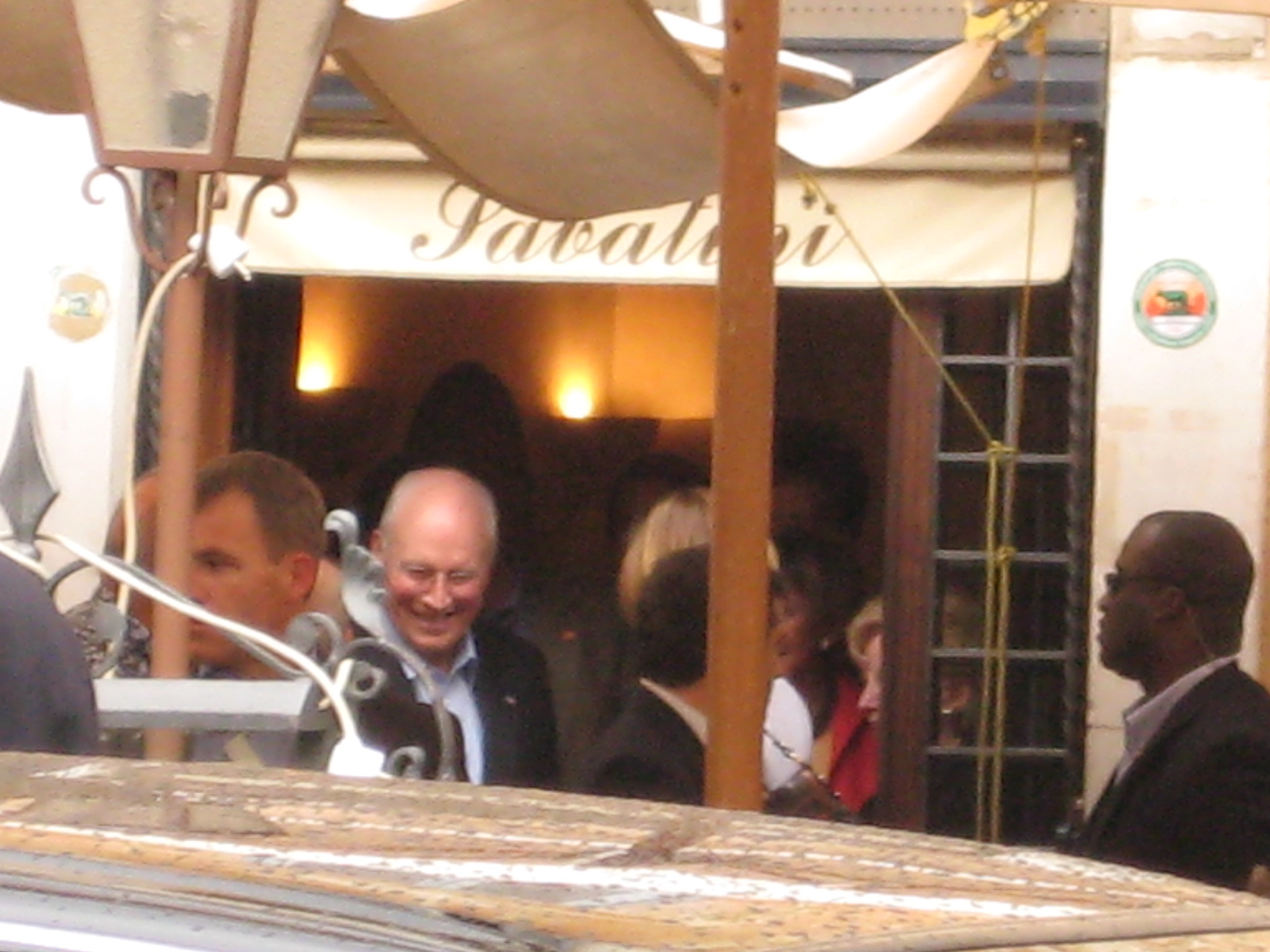
Dick Cheney after having lunch at a Roman Restaurant.  September 7, 2008

Dick Cheney after having lunch at a Roman restaurant. September 7, 2008

I recently finished reading Washington Post reporter Barton Gellman’s book “Angler: The Cheney Vice Presidency.” It’s a tour-de-force of investigative, political, national security, and economic reporting based on a series of articles he co-wrote for the Post last year that won a Pulitzer Prize.

Having lived and worked in Washington DC during the first five years of the Bush presidency, the power and influence of Cheney was clear immediately.  According to Gellman’s book, Cheney’s office was intimately involved in nearly every major policy decision of the administration, and as I found out from my own investigation and field reporting while working at CNN, it was also Ground Zero for one of its biggest scandals.

The most surprising revelation in Gellman’s reporting to me was how he pieced together Cheney’s M.O.  He comes across as the ultimate bureaucratic warrior, knowing how the system works inside out, knowing where the loopholes are, and how to use them to his advantage.

Cheney was not Bush’s svengali or puppetmaster, as many liberals have claimed.  But he still managed to get a lot of his views and positions adopted in the policymaking process at lower levels in the bureaucracy, by placing ideological allies in key middle and senior-level positions throughout the federal government.  By the time the whole process had played itself out and made its way to the president, Cheney’s position nearly always came out on top.

Cheney comes across as something of a zealot, not necessarily because of his hardline conservative ideology but rather, because of his methods.  Even when the subject of the book focused on Iraq, I did not get the impression that Bob Woodward did when he wrote in Plan of Attack that Cheney had a fever regarding the overthrow of Saddam Hussein, a view attributed to Colin Powell, if my memory is correct.

The biggest bombshells in the book were the behind the scenes tick-tock of the Department of Justice’s impasse with the White House over the legality of the NSA’s warrantless wiretapping program, which nearly led to a Saturday Night Massacre-esque decapitation of the national security legal team of the federal government.  The second was the revelation from former House Majority Leader Dick Armey that Cheney misled (if not outright lied) to him about the intelligence on Saddam Hussein’s WMD programs during a private briefing after Armey expressed public doubt about the need to invade Iraq.

What makes the book more impressive is that Gellman was able to get a fair, balanced, and accurate portrayal of Cheney without the benefit of an interview.  He digs deep into the government bureaucracy and spoke extensively with Cheney’s friends and rivals to make sure that a well-rounded picture of his vice presidency came to light.

The major supporting character who pretty much jumps off every page in this book is Cheney’s counsel (and now chief of staff) David Addington, who shares his boss’s views about an expansive, near-unchecked power of the executive branch on matters of war and national security.   Even though Scooter Libby held the chief of staff role until his indictment in 2005, he did not come across in the book anywhere near as big a player in the government as Addington.

This is a very well-written and researched book which, until years pass and internal documents from the Bush White House are declassified and published, will likely be the standard by which all biographies of the Cheney vice presidency will be measured.

Karl Rove has launched a website. As if you needed more tea leaves that McCain was in trouble, the most prominent Republican strategist of his generation is projecting an Obama win in his analysis of the Electoral College map a month out from Election Day.

Separately, this Politico article points out the pressure the McCain campaign is under to defend Virginia, which has voted Republican in every presidential election since 1964. But it also looks at the national map as a whole, and how the unfriendly dynamics of the race are forcing the McCain campaign to adjust in the final stretch:

Beyond the financial implications of that approach, the GOP ticket is confronting new demands on its time. The McCain campaign would prefer to have the Arizona senator and Alaska governor campaign together, but they are now being forced to protect more states so they may have to spend more time apart.

It’s a akin to a campaign version of whack-a-mole, where finite time and money is being spread across the landscape to defend against sudden and unexpected Democratic surges on GOP turf.

Not good omens for the GOP with less than a month to go before the election.

That’s the question elected officials, political observers, and voters are asking about the Republican Party. Traditionally, the incumbent president or the party’s presidential candidate is the designated leader of the party. But in 2008, the two Republicans in this role have been unable to rally their political allies to their will.

George W. Bush is a lame duck president, arguably since his party lost control of Congress in 2006. His approval numbers were already at record lows before the economic crisis, which came down on him and his party like a ton of bricks. A recent poll by ABC News and the Washington Post put his disapproval ratings at a record 70 percent. The same poll finds that 25 percent think the president deserves the most blame for the economic crisis.

GOP presidential nominee John McCain has a very different problem. He has made his political reputation, rightly and wrongly, based on his willingness to buck his party’s leadership and the conservative base, on issues ranging from immigration to the environment to confirmation of judicial nominees. His problem is that he has burned his bridges with the base that it’s difficult for some of the party faithful to get excited about his campaign.

Perhaps the most telling sign of the lack of political capital Bush and McCain with regard to influencing congressional Republicans is the fact that they could not get more than one third of House Republicans to vote in favor of the bill, compared to two thirds of House Democrats who supported it. Another telling statistic about Bush and McCain’s diminished influence in their own congressional delegations, pointed out by Politico’s Jonathan Martin: only 4 out of a combined 23 House Republicans from Texas and Arizona voted for the bailout, and they were all from Texas.

While congressional leaders from both parties came together fairly quickly to try and come up with a solution to the crisis, when McCain called for his joint White House photo op with Obama he may have overly politicized the process and potentially helped to derail negotiations.

After the House vote failed, Congressional Republicans held a press conference to denounce a partisan speech given by Nancy Pelosi on the House floor, and said that she was responsible for the failure to pass the bill.

But voters aren’t buying the spin. According to the ABC/Post poll, 44 percent think that congressional Republicans are responsible for failing to pass the bailout legislation, compared to just 21 percent who blame the Democrats and 17 percent who blame both parties. But voters in general are in a sour mood with Congress. A recent CBS poll put congressional approval ratings at only 15 percent. There is a real and tangible feeling of “Throw the Bums Out” and I think a lot of incumbents up for reelection, particularly in the House, will be sweating bullets on Election Day.

Yes, Democrats have been running Congress for more than 18 months now, so some of the pressures of incumbency might be on them. However, I think perceptions with the voters are hardening, if not solidified, that Republicans controlled both the White House and Congress for most of the last 8 years, and that most of, if not all, the events that led up to this moment of economic crisis happened on their watch.

If McCain loses the election and more GOP incumbents are ousted in the House and Senate, look for another round of circular firing squads and potential changes in their congressional leadership. The vacuum in leadership will force new faces to step up and take over, probably from outside Washington. Keep an eye on who is posturing or making noise to be the GOP frontrunner for 2012. I expect it to begin immediately after the current election is over. My guess is we will be hearing and seeing a lot more of Mitt Romney, Mike Huckabee, and Tim Pawlenty. From the Congress, look for 2012 buzz coming from Rep. Eric Cantor, Sen. John Thune, and former Speaker of the House Newt Gingrich.

Marc Ambinder made a post on this subject worth reading, and the title effectively frames the GOP’s dilemma: “Republicans Are Free Agents Now.”