Archive for the ‘Foreign Policy’ Category

A couple of my friends/Georgetown classmates had good articles published recently I thought I should share here.

From Phillip Padilla (sharing a byline with my former professor Daniel Byman), this article published in Slate about how the Bin Laden operation could have gone wrong.

From Adam Elkus, who blogs over at Rethinking Security, this article about military raiding published in The Atlantic.

Both are well worth taking the time to read.

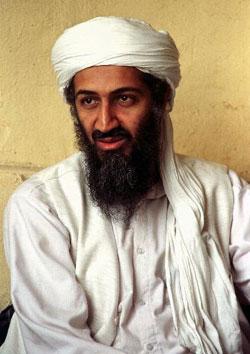
During a background briefing happening now at the Pentagon, a senior intelligence official showed reporters five videos of Osama bin Laden that were recovered by Navy SEALs during the raid on the Bin Laden compound last week.  The videos will be released to the media after the briefing at some point in the next few hours.

According to a quick readout on air from CNN’s Charley Keyes a little while ago, the videos show Bin Laden in a wool cap and blanket on a rocking chair watching TV coverage of himself.  Other videos are practice takes of his videotaped statements.   CNN’s Barbara Starr also pointed out that U.S. officials have removed the audio from the videos before their release, so that they can’t be used for possible propaganda value.

Stay tuned…

Update: The Pentagon fed the five videos, which are now being dissected by every news organization on the planet. Inevitably, #TVShowsBinLadenWatched started trending on Twitter.

In the immediate aftermath of the news that Osama bin Laden had been killed, one of the key questions asked by journalists and policymakers was about Pakistan’s complicity – or the lack thereof.  At the center of this political firestorm is Pakistan’s military and intelligence services, a key domestic political constituency. The Pakistani people and the press are now asking themselves the same uncomfortable questions that were asked about the CIA’s assessments of Saddam Hussein’s nonexistent WMDs: did we get it wrong because of incompetence or because we knew about it and looked the other way?  A secondary question, and perhaps bigger in terms of domestic politics, that has emerged in Pakistan: how did American helicopters loaded with Navy SEALs fly into Pakistani airspace and carry out a 40-minute raid without anyone in the national security apparatus noticing?

The fact that the most wanted man in the world was found living in a suburb of Islamabad approximately three hours outside of Islamabad, where he had been living for years within walking distance of a police station and the Pakistani equivalent of West Point is absolutely astounding. It disproved the conventional wisdom that he had been hiding out this entire time in caves in Pakistan’s Federally Administered Tribal Areas. A Pakistani official familiar with information provided by one of Bin Laden’s wives said that before Abbottabad, the Al Qaeda leader and his family had been living in a village 40 kilometers away near the city of Haripur from as far back as 2003.

Given what we now know about how and where Bin Laden was living makes a decade’s worth of denials from Pakistani leaders ring hollow. However, somebody in the American intelligence community suspected something long before the chilling of U.S.-Pakistani relations of the recent past and last Sunday’s raid. Bill Maher recently dug up a clip from his show from October of 2008 in which then-CNN correspondent Christiane Amanpour said “I just talked to somebody very knowledgeable. She doesn’t think, this woman who is in American intelligence, thinks that he’s [Osama bin Laden] in a villa, a nice comfortable villa in Pakistan, not a cave.”

The criticism and second-guessing of Pakistan has been blistering and relentless since last Sunday. Steve Coll wrote, “The initial circumstantial evidence suggests… that bin Laden was effectively being housed under Pakistani state control.” President Obama’s counterterrorism adviser John Brennan told reporters, “I think it is inconceivable that bin Laden didn’t have a support system in the country that allowed him to remain there for an extended period of time.”

It’s worth keeping in mind that Bin Laden is not the only senior Al Qaeda member to have been caught in an urban area of Pakistan. Khalid Sheikh Mohammed and Abu Faraj al-Libi were apprehended in Rawalpindi and Mardan, respectively, with Pakistani involvement in both operations.

Unfortunately for the Pakistanis, their long track record of denials about Bin Laden’s presence in their country, and the “double game” played by the government – supporting the U.S. effort against Al Qaeda, while at the same time supporting the Taliban and the Haqqani network – means that the burden will be on them to prove that they didn’t know.  This essentially forces them to prove a negative, something which is very difficult to do effectively and beyond dispute.

Pakistan’s intelligence service is already in full-blown damage control mode.  ISI chief Lt. Gen. Ahmad Shuja Pasha is heading to Washington to offer explanations.  The Daily Beast recently reported that Pasha may step down as the government’s fall guy over the Bin Laden intelligence failure.  Pakistan’s embarrassment over the Bin Laden episode may give the United States some political and diplomatic leverage in the short term – perhaps in the form of renewed pressure for actionable intelligence on Mullah Omar or Ayman al-Zawahiri. Expect the U.S.-Pakistan relationship to remain frosty at least until the Pakistanis are able to convince the Obama administration and Congress that they didn’t know Bin Laden’s whereabouts.  However, if evidence emerges that people in the Pakistani government knew about his location and withheld that information from the United States, it will be a whole new ball game.

Update: More Bin Laden raid fallout on the Pakistani domestic political front…  Lawmakers are calling on President Asif Ali Zardari and other senior government officials to resign.

Update II: Apparently part of the ISI’s CYA effort is outing the identity of the local CIA station chief in the Pakistani media.

Update III: Husain Haqqani, Pakistan’s ambassador in Washington, sent out a tweet shooting down the story: “NO, The Nation just ran made up name 4 CIA Stn Chief in I’abad in made up story abt DG ISI’s travels.”

The Times of India puts the whole mess into context.

Update IV: Correction. A previous version of this inaccurately referred to Abbottabad as a suburb of the Pakistani capital city of Islamabad. According to Google Maps, Abbottabad is approximately 70 miles to the north. Thanks to Huffington Post reader Kazim Nawab for pointing that out.
Steve Coll makes the case against doing so.

Although not mentioned in this article, Coll has another relevant historical precedent to draw from. In his seminal work “Ghost Wars,” he wrote extensively about how the U.S. provided the mujahedin in Afghanistan with Stinger missiles and other weapons to level the playing field in their fight against the Soviets. According to Coll, the CIA gave between 2,000 and 2,500 missiles to the Afghan rebels during the course of the war.

After the Soviet withdrawal, “the CIA fretted that loose Stingers would be bought by terrorist groups or hostile governments such as Iran’s for use against American civilian passenger planes or military aircraft.” The Bush and Clinton administrations later authorized a highly secret missile buyback program, with each going between $80,000 and $150,000 a piece. The agency estimated that 600 of them were still at large in 1996 (Coll, Ghost Wars p. 11).   The CIA and the Obama administration would not want to see a replay of this scenario in Libya.

Ali Suleiman Aujali, the former Libyan ambassador to Washington and currently the U.S. representative of the Transitional National Council of the Libyan Republic, has written an op-ed for the Washington Post. Read it.

The current issue of Foreign Policy magazine has a special report titled “The Axis of Upheaval,” with in depth articles on the three countries that could be the source of some of the world’s biggest problems.

I was surprised by their selections, since none of them were obvious choices:

  • New York Times East Africa bureau chief Jeffrey Gettleman says Somalia is the most dangerous place on Earth.
  • Economist Moscow bureau chief Arkady Ostrovsky writes about Vladimir Putin and the risks of Russia in these tough economic times.
  • Los Angeles Times reporter Sam Quinones writes about the escalating drug war in Mexico.
  • All of them are must reads.

    googleearthdrones

    Memo to U.S. military and intelligence agencies: Make sure you block or filter satellite images on Google Earth of your Predator drones when they’re sitting around on a runway in Pakistan.

    ahmadinejad-un

    Mahmoud Ahmadinejad, the president of Iran, has written President-elect Barack Obama a letter congratulating him for his election victory, and said he hoped the new president would “choose to honor the real interests of people and justice and equity over the insatiable appetites of the selfish minority.” Ahmadinejad also said that people want “fundamental change in the American government’s policies, both foreign and domestic.”

    This is an interesting development for several reasons. First, during the campaign Hillary Clinton and John McCain tried to hammer Obama over his willingness to talk to America’s adversaries without preconditions, Iran being one of the countries in question. Second, this is the first time since the Iranian revolution of 1979 that an Iranian president has congratulated an American president-elect.

    You can read an English translation of the full text of the letter here.

    This could be the beginning of an interesting new chapter in U.S.-Iranian diplomatic relations.

    I recently finished reading “Meltdown: The Inside Story of the North Korean Nuclear Crisis” by former CNN correspondent Mike Chinoy. Before I go any further with this, I should note in the interest of full disclosure that Mike was a teacher of mine at USC, and that I transcribed several interviews and contributed some research for this book.

    It’s an excellent read, although the nuances of nuclear proliferation policy may be a bit complicated for a person unfamiliar with the issues surrounding America’s complicated relationship with North Korea. Mike does a good job documenting some of the behind-the-scenes power struggles within the Bush administration. There’s enough duplicity and backstabbing going on to rival any reality TV show, only that there are real world consequences as a result.

    The major characters in this book – secretaries of State Colin Powell and Condoleezza Rice, nonproliferation chief John Bolton, North Korea negotiator Christopher Hill, and others – come across as dedicated public servants regardless of their position on the ideological and diplomatic spectrum in handling the North Korea issue, even when they are at each others’ throats.

    Mike also does a good job at analyzing the M.O. of the North Koreans, parsing through the public and private statements of government officials as well as the official reports from the North Korean news agency to put developments and events into context, and how these comments often foretold of positive or negative developments in the U.S.-North Korea relationship. It’s easy and tempting to try and dismiss the North Koreans for their behavior, and wonder about how accurate the caricature of Trey Parker and Matt Stone’s Kim Jong Il really is (I’ve been guilty of that), but they certainly do not come across this way in the book.

    If there is such a thing as being able to figure out what makes North Korea and Dear Leader tick, Mike is probably pretty close to it. He once said to me words to the effect that Kim Jong Il was as rational as a person could be in an irrational environment. Some of the words and actions of the North Korean government do seem irrational, and even childish at times. Their nuclear test in October of 2006 was neither of these, but rather something akin to Glenn Close’s famous line in the movie Fatal Attraction: “I’m not gonna be ignored.”

    There are no bombshells in this book like George Tenet’s infamous slam dunk comment, but Washington Post diplomatic correspondent Glenn Kessler reviewed Meltdown and has a far better understanding of the news value and significance of what Mike uncovered in the course of his reporting for this book.

    Regardless of who wins the election next week, the next president will have to figure out how to continue dealing with North Korea and make sure that the relationship does not deteriorate the way it did during the past eight years.

    John McCain, Barack Obama and Joe Biden get calls from Bob Gates and Condoleezza Rice about the ongoing Status of Forces Agreement (SOFA) being discussed with the Iraqi government because of their respective roles on the Senate Armed Services and Foreign Relations committees. Sarah Palin… not so much.

    According to the State Department, Palin is a governor with no relevant jurisdiction or oversight of the State Department or Department of Defense, but as this briefing shows, some people aren’t going to be able to help but interpret it as a snub of the Republican vice presidential candidate. From Friday’s daily State Department briefing:

    QUESTION: You called Senator Biden, you called McCain, you called —

    MR. MCCORMACK: Chairman Biden, I guess I should have said.

    QUESTION: Yeah. Did you also call Governor Palin?

    MR. MCCORMACK: No, no. She – if you hadn’t noticed, she’s a governor, not a senator or congressman.

    QUESTION: She’s a vice presidential candidate.

    MR. MCCORMACK: Right.

    QUESTION: She also has extensive foreign affairs experience. (Laughter.)

    MR. MCCORMACK: Look, I explained to you the reasoning behind the phone calls.

    QUESTION: Anything that has to do with Russia, you would have called her?

    Regardless of the substantive issue of whether or not a governor has jurisdiction of foreign policy, as vice presidential candidate, she or any other candidate – regardless of gender or political affiliation – are entitled to get a briefing or courtesy call on this subject so they can be informed as candidates. If she is entitled to receive classified intelligence briefings from the DNI, I see no reason why she shouldn’t be filled in on SOFA.