McClatchy has an interesting story about how the Latin American Left is gloating about the federal government bailout in the United States.   The whole thing is worth reading.

CARACAS, Venezuela — They don’t call him President Bush in Venezuela anymore.

Now he’s known as “Comrade.”

With the Bush administration’s Treasury Department resorting to government bailout after government bailout to keep the U.S. economy afloat, leftist governments and their political allies in Latin America are having a field day, gloating one day and taunting Bush the next for adopting the types of interventionist government policies that he’s long condemned.

“We were just talking about that this morning on the floor,” said Congressman Edwin Castro, who heads the leftist Sandinista congressional bloc in Nicaragua. “We think the Bush administration should follow the same policies that they and the International Monetary Fund have always told us to follow when we have economic problems — a structural adjustment that requires cutting government spending and reducing the role of government.

“One of our economists was telling us that Bush has just implemented communism for the rich,” Castro said.

Pakistan, which has one of the largest military forces in the world, is a declared nuclear power, and has Osama bin Laden, Al Qaeda, and the Taliban running around in their backyard is on the verge of bankruptcy, unless the international community provides the cash to get them out of this mess.

This will make me sleep better at night.

I’ll have more debate analysis later, but I want to point out this moment which everyone is talking about.

I have yet to see the rest of the debate, but the contempt McCain has for Obama practically jumps off the screen.  After the debate, even the normally diplomatic and cautious Wolf Blitzer had to point it out.

As I said before, the town hall format offers plenty of opportunities for candidates to shoot themselves in the foot, and in this case McCain delivered. This is what everyone was talking about after the debate and in the morning papers.

That’s the record low percentage of people who are satisfied with the way things are going in the United States, according to a recent Gallup poll.

Because polls like these tend to be a referendum on the party in power, if I were a Republican campaign operative or candidate, I would lose sleep over this.

McClatchy:

WASHINGTON — In a dramatic setback for the Bush administration, a federal judge ordered the U.S. government Tuesday to immediately transfer to the U.S. and release 17 Chinese-born Muslims detained for seven years at Guantanamo.

Reading his decision from the bench, Judge Ricardo Urbina declared the continued detention of the group from the ethnic Uighur minority to be “unlawful” and ordered the government to transfer the detainees to the U.S. by Friday.

The decision marked the first time a court has ordered the release of Guantanamo detainees into the U.S.

First, this raises a major issue as to what is going to happen to these detainees when they get transferred to the United States. They have two options: Return them to their native China, OR find a third country willing to grant them asylum. Based on the predicament facing the last group of Uighurs released from Guantanamo, I have a feeling that this group will be dealt with the same way.

Second, this is another legal defeat for the administration. After reading several books about the Bush Administration, specifically Barton Gellman’s Angler and Charlie Savage’s Takeover, one common theme keeps popping up: the expansion of executive power at the expense of the other branches of American government.

After two Supreme Court cases and now this decision, the administration is finally learning the costs of overreach. These precedents are now on the books and effectively bind future administrations to abide by them in the future.

An interesting idea from James Fallows.

Less than 12 hours to go before the second presidential debate, this time in the town hall format moderated by Tom Brokaw where the candidates take questions from voters. Here’s a look at what the two candidates need to do, based on the first debate and the events of the last week.

JOHN MCCAIN:
McCain, his campaign, and his operatives have decided to go on a full blast assault on Barack Obama based on his associations with Bill Ayers, Tony Rezko, and to a lesser degree, Jeremiah Wright. The harshly negative tone borders on shrill at times. While Hillary Clinton and her campaign tried to make an issue out of it during the primaries, there was no silver bullet there to sink Obama’s candidacy. Unless some enterprising reporter uncovers a previously undiscovered damning smoking gun, odds are the guilt by association attacks won’t have any impact during the general election either.

The Muslim Manchurian Candidate rumors are beginning to circulate again, and a sheriff at a Palin event in Florida dropped the H-bomb, a comment the McCain campaign called “inappropriate.”

Political operatives and TV pundits say that people are turned off by negative campaigning, but the reality is it works. The risk for the person who goes negative (in this case, McCain) is that in going negative, you risk driving up your own negatives in addition to the other guy’s. A political murder-suicide, if you will.

The point of doing this is not for McCain to win an election, but for Barack Obama to lose it. McCain has been losing since the financial crisis hit, and he is running out of time to change both the media narrative or political momentum in his favor before voters go to the polls. By focusing the narrative of the last day or so on blistering attacks on Barack Obama, McCain has all but guaranteed he will go there during the debate tonight if Tom Brokaw does not.

Looking back at the first debate, McCain got the Al Gore 2000 treatment from the media and the talking heads afterward, when almost everyone pointed out his inability (or refusal, depending on your perspective) to look Barack Obama in the eye when answering a question, even at the encouragement of Jim Lehrer. McCain’s advisors would be guilty of political malpractice if they did not point this out to him and correct it before the debate tonight.

He also needs to avoid any major gaffes, or repeating any of the exaggerated or false lines of attack which have already been well documented and debunked by the press (i.e. the sex ed for kindergarteners ad). If McCain goes there, do not be surprised if Tom Brokaw, if not Barack Obama himself, calls him out on it.

McCain prefers the townhall format, which of course means the Obama campaign is raising expectations of him before the debate.

BARACK OBAMA:
Obama has been in the driver’s seat for the better part of two weeks and continues to build on his momentum in state and national polls. He already held his own in the first debate, which thematically was focused on John McCain’s strong subject.

Obama was clearly prepared for a negative barrage in the home stretch, since he launched a website attacking McCain for his role in the Keating 5 scandal at the same time McCain began hinting of his own negative attacks earlier this week. It wouldn’t be a classic October Surprise for anyone who knows McCain’s history, and the candidate himself has written about it in his own books. But this has more relevance to the current situations than Obama’s dealings with Ayers, Rezko, and Wright because 1) it was part of the biggest banking and financial crisis of its day, which Obama can then try and tie into what is happening right now; and 2) it involves McCain’s behavior and judgment as a U.S. Senator.

Like McCain, Obama needs to avoid making any gaffes in the debate which can be exploited by his opponent. Obama has been very cool in the sense that he doesn’t get rattled or angry during a debate, a benefit of the long hard slog that was the Democratic primary earlier this year. If he can get under McCain’s skin, that might create an unfavorable impression with voters at the debate and watching on TV, as well as the network pundits and talking heads.

As in the first debate, he doesn’t have to do or say anything risky except hold his own. The momentum and the political climate are working to his advantage right now. Given that the top concern on most voters’ minds right now is the economy, that automatically puts Obama at an advantage because polls show that voters prefer him to McCain on dealing with the economy, and the economy will be the focus of a lot of the questions. Because he is leading, a draw in this debate essentially amounts to the same as an outright Obama win.

One thing that both candidates need to be careful about, and it is something beyond either of their control, is the audience. Slate’s John Dickerson has this article on the perils of the town hall format and how it hurt George H.W. Bush during the 1992 campaign. It may be in the substance or tone or body language of their response to the question, but the nature of the town hall format offers plenty of opportunities for candidates to shoot themselves in the foot.

Mr. Ayers, meet Mr. Keating

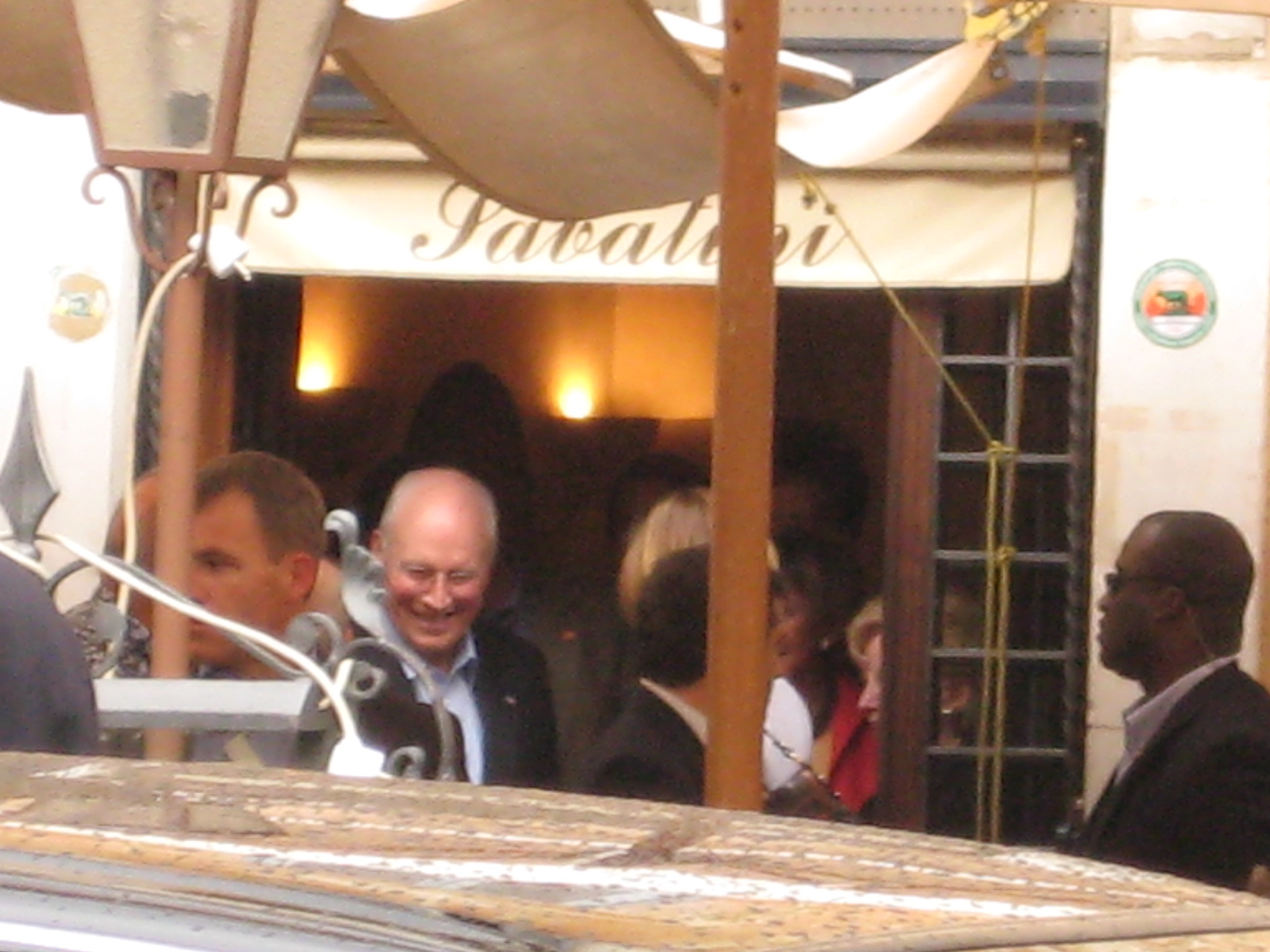
Dick Cheney after having lunch at a Roman Restaurant.  September 7, 2008

Dick Cheney after having lunch at a Roman restaurant. September 7, 2008

I recently finished reading Washington Post reporter Barton Gellman’s book “Angler: The Cheney Vice Presidency.” It’s a tour-de-force of investigative, political, national security, and economic reporting based on a series of articles he co-wrote for the Post last year that won a Pulitzer Prize.

Having lived and worked in Washington DC during the first five years of the Bush presidency, the power and influence of Cheney was clear immediately.  According to Gellman’s book, Cheney’s office was intimately involved in nearly every major policy decision of the administration, and as I found out from my own investigation and field reporting while working at CNN, it was also Ground Zero for one of its biggest scandals.

The most surprising revelation in Gellman’s reporting to me was how he pieced together Cheney’s M.O.  He comes across as the ultimate bureaucratic warrior, knowing how the system works inside out, knowing where the loopholes are, and how to use them to his advantage.

Cheney was not Bush’s svengali or puppetmaster, as many liberals have claimed.  But he still managed to get a lot of his views and positions adopted in the policymaking process at lower levels in the bureaucracy, by placing ideological allies in key middle and senior-level positions throughout the federal government.  By the time the whole process had played itself out and made its way to the president, Cheney’s position nearly always came out on top.

Cheney comes across as something of a zealot, not necessarily because of his hardline conservative ideology but rather, because of his methods.  Even when the subject of the book focused on Iraq, I did not get the impression that Bob Woodward did when he wrote in Plan of Attack that Cheney had a fever regarding the overthrow of Saddam Hussein, a view attributed to Colin Powell, if my memory is correct.

The biggest bombshells in the book were the behind the scenes tick-tock of the Department of Justice’s impasse with the White House over the legality of the NSA’s warrantless wiretapping program, which nearly led to a Saturday Night Massacre-esque decapitation of the national security legal team of the federal government.  The second was the revelation from former House Majority Leader Dick Armey that Cheney misled (if not outright lied) to him about the intelligence on Saddam Hussein’s WMD programs during a private briefing after Armey expressed public doubt about the need to invade Iraq.

What makes the book more impressive is that Gellman was able to get a fair, balanced, and accurate portrayal of Cheney without the benefit of an interview.  He digs deep into the government bureaucracy and spoke extensively with Cheney’s friends and rivals to make sure that a well-rounded picture of his vice presidency came to light.

The major supporting character who pretty much jumps off every page in this book is Cheney’s counsel (and now chief of staff) David Addington, who shares his boss’s views about an expansive, near-unchecked power of the executive branch on matters of war and national security.   Even though Scooter Libby held the chief of staff role until his indictment in 2005, he did not come across in the book anywhere near as big a player in the government as Addington.

This is a very well-written and researched book which, until years pass and internal documents from the Bush White House are declassified and published, will likely be the standard by which all biographies of the Cheney vice presidency will be measured.

New York Daily News:

“It’s a dangerous road, but we have no choice,” a top McCain strategist told the Daily News. “If we keep talking about the economic crisis, we’re going to lose.”

FYI, the phrase means “In loss, there is the truth” in Latin, a variation of a famous phrase attributed to Pliny the Elder.